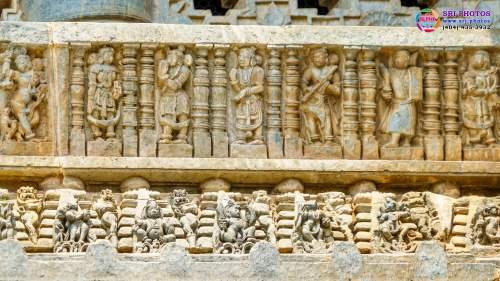
Hoysaleswara Temple, Halebidu - Album 7
The Hoysaleswara Temple in Halebidu, Karnataka, constructed between 1121 CE and 1160 CE under King Vishnuvardhana, is a vibrant center of Shaivite worship. Located in the former Hoysala capital of Dwarasamudra, this dvikuta temple, dedicated to Lord Shiva as Hoysaleswara and Shantaleswara, is a proposed UNESCO World Heritage Site. Managed by the Archaeological Survey of India (ASI) and the Hindu Religious and Charitable Endowments (HR&CE) Department, the temple remains active, hosting daily rituals and festivals that draw devotees and reflect its enduring spiritual significance.
Religious Practices
The Hoysaleswara Temple is an active site of worship, centered around its two Shiva Lingams in the twin sanctums. Daily rituals, conducted by priests trained in Agama Shastra, include abhishekam (ritual bathing of the Lingams with milk, curd, and ghee), archana (offering of flowers and chants), and aarti (lamp ceremonies). These rituals, performed at dawn, noon, and dusk, create a sacred ambiance, with the air filled with the scent of sandalwood and the sound of bells. The temple’s east-west alignment ensures the Lingams are illuminated by sunrise during specific rituals, enhancing their spiritual potency.
Major festivals, such as Maha Shivratri and Kartika Purnima, attract thousands of devotees. During Maha Shivratri, the temple is adorned with flowers and oil lamps, with all-night vigils featuring Rudrabhishekam and recitations of Shiva’s hymns. The Hoysala Mahotsava, a cultural festival, includes dance and music performances in the mandapa, echoing the temple’s historical role as a performance venue. Inscriptions record endowments for perpetual lamp lighting and ritual offerings, a practice continued today through devotee contributions.
The temple’s pluralistic iconography, including Jain and Vaishnavite motifs, reflects the Hoysalas’ inclusive patronage, influenced by Queen Shantala Devi’s Jain faith. This diversity is evident in rituals honoring Ganesha, Parvati, and Tirthankaras alongside Shiva.
Architectural Context
The temple, built on a 32-point stellate platform, features over 1,000 friezes depicting mythological scenes and deities, with lathe-turned pillars and ornate ceilings in the mandapa. Two 9-foot Nandi statues guard the entrance, symbolizing devotion to Shiva.
Historical Significance
Commissioned by Vishnuvardhana, the temple survived 14th-century invasions, with its core structure preserved by local communities. Its inscriptions provide insights into Hoysala religious and economic practices.
Visitor Information
Located 31 km from Hassan, the temple is open from 6:30 AM to 9:00 PM. Visitors should attend evening aarti for a spiritual experience and visit during October–February. Guided tours offer context on rituals, with the ASI museum nearby displaying artifacts.
Photography & Videography by Sri Photos | https://www.sri.photos/
Please follow, like and share us on social media. Please call (404) 435-3932 for Photos | Videos | 360° Photos | 360° Videos | Live Coverage