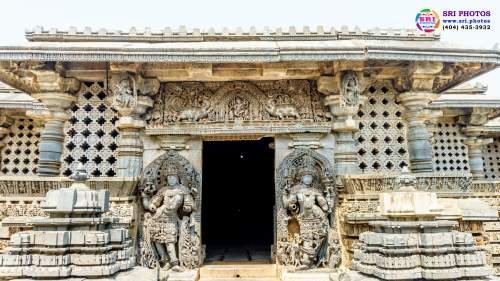
Hoysaleswara Temple, Halebidu - Album 6
The Hoysaleswara Temple in Halebidu, Karnataka, India, constructed between 1121 CE and 1160 CE under King Vishnuvardhana, is a pinnacle of Hoysala engineering and artistry. Located in the former capital of Dwarasamudra, this dvikuta (twin-shrined) temple dedicated to Lord Shiva is renowned for its intricate soapstone carvings and stellate design. A proposed UNESCO World Heritage Site, the temple, despite damage from 14th-century invasions, showcases advanced construction techniques that highlight the Hoysala Empire’s architectural ingenuity. Managed by the Archaeological Survey of India (ASI), it remains a testament to medieval Indian craftsmanship.
Construction Techniques
The Hoysaleswara Temple was built using chloritic schist (soapstone), sourced from quarries near Tumkur and Hassan, approximately 50–60 km away. This soft stone, which hardens with exposure, allowed artisans to carve intricate details with precision. The temple, measuring 105 meters long, 64 meters wide, and 9 meters high, was constructed on a stellate (star-shaped) jagati (platform) with 32 angles, requiring precise mathematical planning to ensure structural stability. Interlocking stone blocks, fitted without mortar, provided a robust foundation, with the platform’s design distributing weight evenly across the uneven terrain of Halebidu.
Artisans, organized into guilds under master sculptors like Ketana, Manthuka, and Malithamma, carved the stone in situ, using scaffolding to access higher sections. The temple’s exterior, adorned with over 1,000 friezes and 340 sculptural panels, was crafted with chisels and hammers, achieving minute details like jewelry and facial expressions. The lathe-turned pillars, a Hoysala specialty, were shaped using rudimentary turning tools, producing polished, mirror-like surfaces. Each pillar, unique in its geometric and floral motifs, required weeks of labor, with artisans signing their work, a rare practice in Indian temple architecture.
The stellate platform and curvilinear shikharas (superstructures) demanded advanced geometric knowledge, with artisans aligning the temple along an east-west axis for ritualistic purposes. The construction process, spanning decades, was funded by royal grants and merchant contributions, as recorded in Kannada inscriptions. These endowments also supported artisans with land and privileges, fostering a collaborative ecosystem. The temple’s two massive Nandi statues, each 9 feet long and carved from single soapstone blocks, exemplify the scale and skill of Hoysala stonework.
Architectural Highlights
The dvikuta structure features two sanctums for Hoysaleswara and Shantaleswara, each housing a Shiva Lingam, connected by a navaranga (pillared hall). The exterior friezes depict elephants, lions, mythological scenes, and dancers, while the upper panels showcase deities like Shiva and Vishnu. The interior mandapa contains ornate ceilings and lathe-turned pillars, with perforated jalis filtering light.
Historical Context
Commissioned by Vishnuvardhana and Queen Shantala Devi, the temple reflects the Hoysala Empire’s zenith. Despite invasions by the Delhi Sultanate in 1311 CE, which destroyed the gopurams, the core structure endured, preserved by local communities until ASI stewardship.
Visitor Information
Located 31 km from Hassan, the temple is open from 6:30 AM to 9:00 PM, with no entry fee. Visitors should explore during October–February, using guided tours to understand the engineering marvels. The ASI museum nearby displays related artifacts.
Photogrphy by Suresh K Volam | https://www.sri.photos