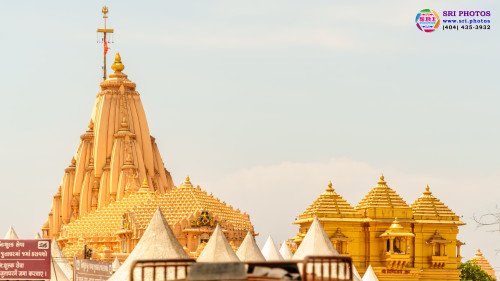
Someshwara Jyotirlinga Temple, Somnath
The Somnath Temple, also known as the Someshwara Jyotirlinga Temple, stands on the shore of the Arabian Sea at Prabhas Patan near Veraval in Gujarat’s Gir Somnath district. Revered as the first among the twelve Jyotirlingas of Lord Shiva, it is one of the most sacred pilgrimage sites in Hinduism. Known as the “Eternal Shrine,” the temple has a history of repeated destruction and reconstruction spanning more than a millennium, making it a powerful symbol of resilience, devotion, and cultural continuity. The present structure, completed in 1951, rises dramatically against the ocean, its curvilinear shikhara visible from afar and its sanctum facing the open sea.
Historical Journey
According to tradition, the original temple was built by the Moon God Soma (Chandra) in gold after Shiva relieved him of a curse that caused him to lose his radiance. Later reconstructions are attributed to Ravana in silver, Lord Krishna in wood, and various kings in stone. Scriptural references appear in the Rigveda, Skanda Purana, and Shiva Purana, establishing Somnath (literally “Lord of the Moon”) as an ancient and highly venerated tirtha. Historically, a significant stone temple existed at the site by the early medieval period. Archaeological evidence and inscriptions point to construction and renovation phases under the Maitrakas of Valabhi, the Gurjara-Pratiharas, and especially the Chaulukya (Solanki) rulers of Gujarat. By the 11th century the temple had become one of the wealthiest and most celebrated shrines in western India.
The most famous destruction occurred in 1025–26 CE when Mahmud of Ghazni sacked the temple, looting its treasures and damaging the structure. Subsequent attacks followed under Alauddin Khilji’s forces in 1299, Muzaffar Shah in the late 14th century, and later rulers including Aurangzeb in the early 18th century. Each time the temple was rebuilt by local rulers or devotees. Queen Ahilyabai Holkar of Indore constructed an adjacent shrine in the late 18th century to maintain continuous worship. After India’s independence, Sardar Vallabhbhai Patel resolved to restore the temple as a national endeavour. The ruins of the previous structure were cleared, and reconstruction began under the guidance of the Sompura community of traditional temple architects, led by Prabhashankar Oghadbhai Sompura. The new temple was consecrated on 11 May 1951 by India’s first President, Dr. Rajendra Prasad. Funded largely through public donations, the project was presented as an act of cultural revival and national pride.
Architectural Significance
The present Somnath Temple is built in the Māru-Gurjara (Chaulukya or Solanki) style, specifically the “Kailash Mahameru Prasad” form characteristic of medieval western Indian temple architecture. Constructed primarily of sandstone, it follows the classical Nagara layout of a garbhagriha (sanctum), antarala (vestibule), sabhamandapa (assembly hall), and nrityamandapa (dance hall). The main shikhara rises approximately 155 feet (about 47 metres) above the sanctum and is crowned by a large kalasha and a tall flagstaff. The tower is of the clustered type, with the central spire supported by ascending rows of smaller urushringas, creating the serrated mountain-like silhouette typical of mature Māru-Gurjara design. The exterior walls feature finely carved panels depicting deities, celestial beings, musicians, floral motifs, and geometric patterns. The temple incorporates both newly carved elements and some recovered fragments from earlier structures.
The temple is oriented so that its sanctum faces the Arabian Sea. A notable feature is the Baan Stambh (Arrow Pillar) on the sea-protection wall. This stone pillar is notable for an inscription stating that there is no landmass in a straight line between its location and the South Pole (Antarctica). Facing the open Arabian Sea, the pillar marks a unique geographical alignment of the temple’s seashore and has long been regarded as evidence of the advanced observational knowledge of ancient Indian architects and navigators. It remains one of the most distinctive and frequently noted features of the Somnath site, drawing the attention of both pilgrims and visitors interested in the temple’s historical and scientific associations. The complex stands close to the Triveni Sangam, the confluence of the Hiran, Kapila, and (mythical) Saraswati rivers, adding further sanctity to the site. The overall composition balances monumental scale with refined surface ornament, presenting a complete and coherent example of the western Indian temple tradition revived in the mid-20th century.
Religious and Cultural Importance
As the Adi (first) Jyotirlinga, Somnath holds a unique place in Shaiva tradition. The lingam in the sanctum is regarded as a self-manifested (swayambhu) form of Shiva. Daily rituals include multiple aartis, abhishekam, and special observances during Shravan, Maha Shivaratri, and Kartik Purnima. The temple’s location on the coast and its association with the lunar deity link it to themes of time, cycles of destruction and renewal, and cosmic order. The repeated rebuilding of the shrine has made it a potent symbol of endurance. In the modern era it has also come to represent the recovery of cultural heritage after independence. A light-and-sound show presented in the evenings narrates the temple’s long history against the backdrop of the sea.
Present Status and Visitor Experience
The temple is administered by the Shree Somnath Trust and remains an active centre of worship open to all devotees. Darshan is free, with regulated entry and security arrangements. Timings generally run from early morning until late evening, with specific slots for aarti and special poojas. Photography is restricted inside the sanctum. A sound-and-light show is offered most evenings (except during the monsoon).
Visitors experience the temple as both a living place of pilgrimage and a striking architectural landmark. The combination of the soaring shikhara, the sound of the waves, the Baan Stambh, and the carefully maintained sandstone surfaces creates a powerful setting. The Somnath Temple continues to stand as a monumental expression of faith, architectural continuity, and historical resilience—an enduring shrine where the Arabian Sea meets one of India’s oldest living traditions of Shiva worship.
Photography by Suresh K Volam | Sri Photos : http://www.sri.photos