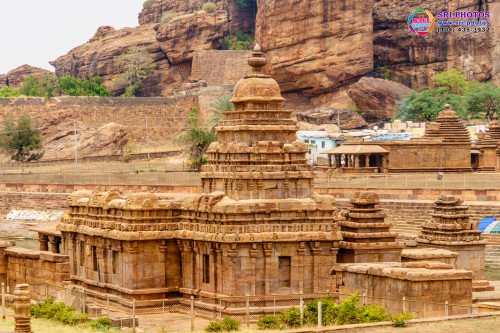
Bhootanatha Temple, Badami - Album 2
The Bhootanatha Temple complex (Kannada: ಭೂತನಾಥ ದೇವಾಲಯ) stands on the eastern shore of the Agastya Tirtha lake in Badami, Bagalkot district, Karnataka, India. Comprising two principal temples—Bhootanatha I (older, smaller) and Bhootanatha II (larger, more developed)—along with subsidiary shrines and a Nandi pavilion, the site is one of the most picturesque in Badami. The red sandstone structures rise directly from the water’s edge, their towers and walls mirrored in the lake, creating a serene and almost ethereal scene at dawn and dusk.
Historical Importance
Badami served as the capital of the Early Chalukyas (c. 543–757 CE) from the time of Pulakeshin I. The Bhootanatha temples are attributed to the reigns of Mangalesha (r. 597–609 CE) and Vikramaditya II (r. 733–746 CE), though no direct inscription dates them precisely. The temple is dedicated to Shiva in his Bhootanatha form (Lord of Spirits or Bhutas), a fierce aspect linked to cremation grounds, the dissolution of life and protection of devotees from malevolent forces. The Agastya Tirtha lake, named after the sage Agastya who is said to have performed penance here, was already a sacred site by the 6th century, making Bhootanatha a major Shaiva pilgrimage centre.
The Chalukyas, while patrons of both Vaishnavism and Jainism, maintained a special devotion to Shiva. The Bhootanatha complex reflects their mature architectural phase, following the rock-cut experiments at Badami’s famous caves and preceding the grander structural temples at Pattadakal. The site remained in continuous worship and was spared large-scale destruction during later invasions.
Architectural Significance
The complex illustrates the development of Chalukyan structural architecture from simple flat-roofed shrines to fully articulated Dravida-style temples.
Bhootanatha I (Older Temple)
This modest, early structure (late 6th or early 7th century) consists of a square garbhagriha with a flat roof and a small porch. Its walls are plain, relieved only by pilasters and a simple kapota moulding. The sanctum contains a Shiva linga, and the temple is considered one of the oldest surviving free-standing shrines in Badami.
Bhootanatha II (Main Temple)
Dating to the 8th century, this is a more mature Dravida-style temple with a three-tiered pyramidal vimana, a vestibule (antarala) and a pillared mandapa. The vimana features kuta-sala elements and miniature aedicules typical of early Chalukyan Dravida. The exterior walls are articulated with pilasters, shallow niches and floral bands. The mandapa ceiling displays a large lotus medallion surrounded by eight directional guardians (ashtadikpalakas).
Subsidiary features
A separate Nandi shrine with a large monolithic bull faces the main temple. To the north lies a small Saptamatrika shrine and a ruined pavilion with lathe-turned pillars. The entire complex rests on a moulded basement with friezes of elephants, lions and makaras. All structures are built of locally quarried red sandstone, the same material used for Badami’s cave temples and fort. The carvings are refined yet restrained, reflecting the Chalukyan aesthetic of elegance over exuberance.
Sculptural Highlights
- The main garbhagriha houses a Shiva linga with a Nandi in the mandapa.
- Wall niches contain Shiva in forms such as Nataraja, Ardhanarishvara and Bhootanatha.
- Doorways feature dwarapalas, Ganga-Yamuna figures, mithunas and floral scrolls.
- Ceiling panels include lotus motifs and dancing figures, showcasing the Chalukyan mastery of symmetry and proportion.
Present Status and Visitor Experience
Protected as a Monument of National Importance by the Archaeological Survey of India, the Bhootanatha Temple remains an active place of worship with daily rituals. The site is especially beautiful at sunrise, when the golden light illuminates the sandstone and the lake reflects the towers in perfect symmetry. Evening light casts long shadows across the water, and the gentle lapping of waves creates a meditative atmosphere. Visitors often reach the temple by descending stone steps from the main road or walking along the lake’s edge from Badami’s cave temples. The complex is less crowded than Pattadakal or Aihole, offering a peaceful setting for photography, reflection and quiet exploration.
The Bhootanatha Temple is a poetic jewel in Badami’s architectural crown. Its modest scale, lakeside setting and timeless elegance make it one of the most evocative monuments of the Early Chalukyas—a place where architecture, water and devotion blend into a serene and unforgettable whole.
Photography by Suresh K Volam | Sri Photos : http://www.sri.photos