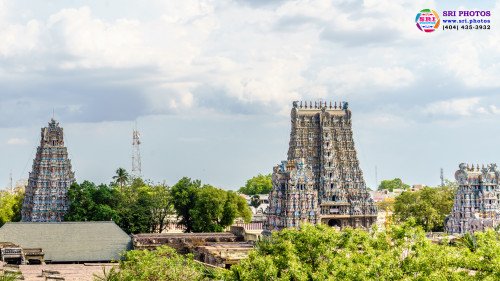
Arulmigu Meenakshi Sundareswarar Temple, Madurai
The Arulmigu Meenakshi Sundareswarar Temple (also known as Meenakshi Amman Temple or Meenakshi Sundareswarar Temple) is a historic Hindu temple complex located on the southern bank of the Vaigai River in the heart of Madurai, Tamil Nadu, India. Dedicated to the goddess Meenakshi (a form of Parvati) and her consort Sundareswarar (a form of Shiva), the temple is one of the most important pilgrimage centers in South India and a supreme example of Dravidian architecture. Covering approximately 14 acres and enclosed by high walls with 14 towering gopurams (gateway towers), the complex forms the living heart of the ancient temple city of Madurai. It attracts tens of thousands of devotees daily and stands as a profound expression of Shaiva, Shakta, and Vaishnava traditions.
Historical Journey
The temple’s origins are rooted in antiquity. Madurai itself is mentioned in Sangam literature (1st–4th centuries CE) as a major urban and cultural center. The existence of a shrine is referenced in Tamil texts from the 6th century CE, and the site is one of the Paadal Petra Sthalams—Shiva temples glorified in the Tevaram hymns of the Nayanar saints (6th–9th centuries CE). Early structural elements of the present temple date to the Pandya period in the 12th–13th centuries. King Sadayavarman Kulasekaran I (r. 1190–1216) and later Pandya rulers contributed significantly to the central shrines and the eastern gopuram. In 1311 CE, the temple suffered severe damage during the invasion led by Malik Kafur of the Delhi Sultanate. It was subsequently rebuilt and expanded under the Vijayanagara Empire in the 14th–15th centuries.
The temple received its present monumental form primarily during the rule of the Madurai Nayaks in the 16th and 17th centuries. Vishwanatha Nayaka and especially Tirumala Nayaka (r. 1623–1659) undertook extensive reconstruction and enlargement, adding the towering outer gopurams, massive pillared halls, and the overall concentric layout that defines the complex today. Later repairs and restorations continued into the 18th–20th centuries, with major conservation work completed in the late 20th century. The temple remains an active center of worship under the administration of the Tamil Nadu Hindu Religious and Charitable Endowments Department.
Architectural Significance
The Meenakshi Temple is a classic and mature expression of Dravidian (specifically Nayaka-period) architecture. The complex is organized in concentric rectangular enclosures (prakaras) aligned to the cardinal directions, with the two main sanctums at the center. The outer walls are pierced by four massive nine-storied gopurams, one on each side, while additional smaller gopurams mark inner gateways, bringing the total to 14.
The tallest is the southern gopuram, rising approximately 170 feet (52 meters). These towers are constructed with solid granite bases and brick-and-plaster superstructures covered in thousands of brightly painted stucco figures depicting deities, mythical beings, dancers, animals, and narrative scenes from the Puranas and the local Tiruvilaiyadal Puranam (the 64 divine sports of Shiva in Madurai). The southern tower alone contains over 1,500 such figures. The figures are periodically restored and repainted, traditionally every 12 years during the Kumbhabhishekam ceremony.
Inside the complex, the architecture is characterized by vast colonnaded halls (mandapas), intricately carved granite pillars, and a large sacred tank. The famous Ayirakkal Mandapam (Thousand-Pillar Hall), built around 1569 CE by Ariyanatha Mudaliar, contains 985 elaborately sculpted pillars featuring Yalis (mythical composite creatures), deities, musicians, and portrait sculptures. Other notable halls include the Ashta Shakti Mandapam and the Kambattadi Mandapam. The two main sanctums are crowned by gold-plated vimanas, which remain relatively modest in height compared to the soaring outer gopurams—a hallmark of later Dravidian temple design in which the gateway towers dominate the skyline. The overall plan reflects both ritual hierarchy and urban scale: the outermost towers announce the sacred space from afar, while successive gateways and halls progressively lead the devotee inward toward the dark, intimate sanctums of Meenakshi and Sundareswarar.
Sacred Spaces and Iconography
At the heart of the complex stand the two parallel sanctums. Meenakshi’s shrine houses the green-stone image of the goddess, depicted with a parrot and fish-shaped eyes (the meaning of her name). Sundareswarar’s shrine contains the lingam of Shiva. The temple uniquely elevates the goddess to equal or even primary status alongside her consort, reflecting the strong Shakta traditions of the region. The Potramarai Kulam (Golden Lotus Tank) is a large rectangular reservoir surrounded by colonnades. Its walls once featured painted murals depicting Shiva’s miracles in Madurai. The tank remains central to ritual bathing and festival processions. Throughout the complex, sculptures and paintings narrate the divine marriage of Meenakshi and Sundareswarar, the 64 leelas of Shiva, and episodes involving Vishnu (regarded as Meenakshi’s brother), creating a rich theological synthesis of Shaivism, Shaktism, and Vaishnavism.
Cultural Significance and Present Status
The temple is the spiritual and cultural nucleus of Madurai. Its annual Chithirai Festival (Meenakshi Tirukalyanam) re-enacts the divine wedding and draws hundreds of thousands of devotees. Other major festivals include the Float Festival, Navaratri, and Karthika Pournami. The temple also functions as a living institution with daily rituals, music, dance, and scholarly traditions. Today the complex is one of the most visited temples in India, receiving 15,000–25,000 visitors on ordinary days and far larger numbers during festivals. It is open daily from early morning to late evening (with a midday closure). Non-Hindus may enter the outer areas, halls, and tank precincts but are generally not permitted into the innermost sanctums. The temple continues to undergo periodic conservation and ritual renewal, ensuring that its towering gopurams and sculptural wealth remain vibrant.
The Meenakshi Sundareswarar Temple stands as a monumental expression of South Indian sacred architecture and living devotion—a city within a city where mythology, art, and faith converge under the colorful spires that have defined Madurai’s skyline for centuries.
Photography by Suresh K Volam | Sri Photos : http://www.sri.photos