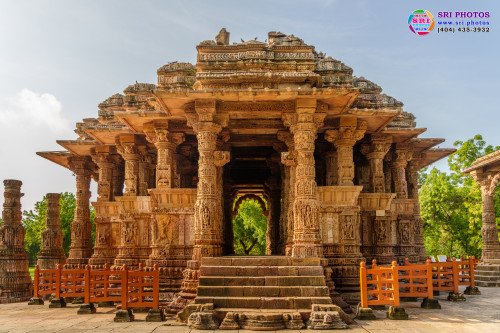
Sun Temple, Modhera
History and Historical Importance
The Sun Temple at Modhera, located in Mehsana district of Gujarat, India, is one of the finest surviving examples of 11th-century temple architecture in western India. Situated on the left bank of the Pushpavati River, approximately 100 km northwest of Ahmedabad, the temple is dedicated to Surya, the solar deity. Constructed during the reign of King Bhima I (Bhimdev I) of the Chaulukya (Solanki) dynasty, it was completed shortly after 1026–27 CE. The complex stands as a powerful expression of Solanki royal patronage, astronomical knowledge, and the Maru-Gurjara architectural style.
Historical Journey
An inscription on the western wall of the shrine records the date as Vikram Samvat 1083 (1026–27 CE). The temple was built soon after the raid of Mahmud of Ghazni on Gujarat in 1024–25 CE, most likely as an act of restoration and assertion of Solanki authority. The Solankis claimed Suryavanshi (solar) lineage, and the construction of a grand temple to Surya reinforced both religious devotion and political legitimacy. The dynasty’s capital at Anahilapataka (modern Patan) was at the height of its power, controlling important trade routes and fostering a distinctive regional architectural tradition.
The temple complex was conceived as a complete sacred landscape of three axially aligned components: the Gudha Mandapa (shrine hall with sanctum), the Sabha Mandapa (assembly or dance hall), and the large stepped reservoir known as the Suryakunda (or Ramakunda). Later additions, including refinements to the dancing hall and gateways, were made during the reign of Karna I in the third quarter of the 11th century.
After the decline of Solanki power in the mid-13th century, the temple suffered further damage during Delhi Sultanate invasions, particularly under Aladdin Khilji. The original idol of Surya was removed or destroyed, and regular worship eventually ceased. Despite these setbacks, the structural core and an extraordinary wealth of sculpture survived. Local traditions link the site to the Ramayana, associating the tank with Lord Rama’s yajna and giving it the name Ramakunda.
Architectural and Cultural Significance
The temple is a classic example of the mature Maru-Gurjara (Chaulukya) style, characterized by precise geometry, profuse ornamentation, and symbolic depth. Its east-west orientation was carefully calculated so that the first rays of the rising sun on the equinoxes would pass through the assembly hall and illuminate the sanctum.
In modern times the monument is protected by the Archaeological Survey of India as a Monument of National Importance. In December 2022 it was added to UNESCO’s Tentative List of World Heritage Sites. The historical importance of Modhera lies in its role as a synthesis of devotion, astronomy, and architectural innovation — a high point of Solanki cultural achievement that continues to embody the political ambition and intellectual sophistication of 11th-century western India.
Present Status and Legacy
No longer an active place of worship, the Sun Temple remains a major heritage site. It hosts the annual Modhera Dance Festival, during which classical performances take place against the illuminated backdrop of the temple and tank. Visitors experience a monument that still communicates the Solanki vision of cosmic order and royal devotion nearly a thousand years after its construction.
The Sun Temple at Modhera stands as an enduring testament to the resilience of Indian architectural traditions and the lasting reverence for the Sun as the source of life and cosmic order.
Photography by Suresh K Volam | Sri Photos : http://www.sri.photos