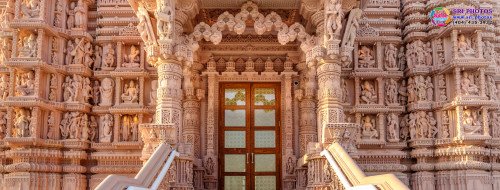
BAPS Hindu Mandir, Abu Dhabi - Album 2
The BAPS Hindu Mandir in Abu Dhabi is the first traditional Hindu stone temple in the Middle East and the largest Hindu temple in West Asia. Located in Abu Mureikhah (near Al Rahba, off the Dubai–Abu Dhabi Sheikh Zayed Highway), the mandir rises from the desert landscape as a radiant symbol of interfaith harmony, India–UAE friendship, and timeless spiritual architecture. Inaugurated on 14 February 2024 by Mahant Swami Maharaj of the BAPS Swaminarayan Sanstha and Indian Prime Minister Narendra Modi, it stands on 27 acres of land gifted by UAE President Sheikh Mohamed bin Zayed Al Nahyan. The temple complex has already welcomed over 2.2 million visitors in its first year, drawing people of all faiths and nationalities.
Historical Journey
The vision for a Hindu mandir in Abu Dhabi originated in 1997, when Pramukh Swami Maharaj (spiritual leader of BAPS, 1921–2016) prayed amid the sand dunes of Sharjah that a temple be built which would bring together people of different faiths, cultures, and countries. Nearly two decades later, in 2015, then Crown Prince Sheikh Mohamed bin Zayed Al Nahyan generously allocated land for the project. In February 2018, the project was formally launched. Sheikh Mohamed chose a traditional stone temple design over a modern alternative, and the foundation stone was laid in April 2019.
Construction began in December 2019 and continued through the COVID-19 pandemic. Over 2,000 skilled artisans in Rajasthan and Gujarat hand-carved the intricate stonework, while more than 200 volunteers from around the world contributed hundreds of thousands of hours. The temple was consecrated through a traditional Vedic pran-pratishtha ceremony on 14 February 2024, followed by a public dedication that same day. It opened to the public shortly thereafter and quickly became a landmark of cultural diplomacy and spiritual inclusivity.
Architectural Significance
Built according to ancient Shilpa Shastras (Hindu architectural treatises) in the traditional Nagara style, the mandir measures 108 feet (32.9 meters) in height, 262 feet (79.8 meters) in length, and 180 feet (54.9 meters) in width. Its most striking feature is the seven shikharas (spires), which symbolize the seven emirates of the UAE. These are complemented by two large domes (ghumats), 12 pyramidal domes (samrans), and 402 intricately carved pillars.
The exterior is clad in pink sandstone sourced from Rajasthan, while the interiors feature pristine white Italian marble. Approximately 20,000 tonnes of stone and marble—carved into more than 25,000 individual pieces—were shipped to Abu Dhabi in over 700 containers. Remarkably, the structure uses no reinforced steel or concrete. Instead, it employs traditional interlocking stone techniques combined with modern engineering for earthquake resistance and durability in extreme desert conditions. Sensors monitor structural health, and heat-resistant materials ensure visitor comfort.
The carvings narrate stories from the Ramayana, Mahabharata, Bhagavata Purana, and other Hindu scriptures, alongside motifs of universal harmony drawn from diverse cultures. Panels also incorporate regional elements such as Arabian camels, oryx, and falcons alongside traditional Indian symbols like elephants and peacocks. Two notable domes—the Dome of Harmony (representing the five natural elements) and the Dome of Peace—further emphasise the temple’s message of unity.
Sacred Spaces and Complex Features
The mandir houses seven main shrines dedicated to deities representing different regions of India:
- Bhagwan Swaminarayan and Gunatitanand Swami
- Radha-Krishna
- Sita-Rama
- Shiva-Parvati (with Ganesha and Kartikeya)
- Venkateshwara (Tirupati Balaji)
- Jagannath
- Ayyappa
Visitors approach the temple by walking past water channels symbolising the Ganga and Yamuna rivers, with a beam of light representing the Saraswati. A series of brass bells invites devotees to ring them before entering. The complex also includes a visitor center, exhibition halls, learning areas, thematic gardens (Harmony and Faith parks), an amphitheater, community halls, a food court, children’s play areas, and a gift shop. The overall site can accommodate thousands of visitors daily, with capacity for large gatherings during festivals.
Cultural and Spiritual Importance
More than a place of worship, the BAPS Hindu Mandir embodies the UAE’s commitment to tolerance and coexistence. Open to people of all faiths, it hosts interfaith events, cultural programmes, and major Hindu festivals such as Diwali, Janmashtami, Maha Shivratri, and Holi. It stands as a living bridge between Indian spiritual traditions and the multicultural fabric of the Gulf, reinforcing the principle of Vasudhaiva Kutumbakam (the world is one family).
The temple’s construction also revived traditional stone-carving skills, providing livelihood to thousands of artisans and preserving a craft that dates back centuries. Its seamless blend of ancient techniques with modern sustainability measures makes it a 21st-century architectural achievement rooted in timeless values.
Present Status and Visitor Experience
The mandir is open Tuesday to Sunday from 9:00 AM to 8:00 PM (closed on Mondays for visitors). Entry is free, but advance online registration is mandatory. Modest dress, removal of footwear, and respectful conduct are required. Ganga Aarti is performed in the evenings.
A visit typically includes a walk through the landscaped grounds, darshan of the seven shrines, appreciation of the detailed carvings, and time in the exhibition spaces. The desert setting, combined with the glowing pink sandstone and cool marble interiors, creates a profound sense of serenity and wonder. The BAPS Hindu Mandir Abu Dhabi stands as a luminous testament to harmony—where the ancient art of Indian temple architecture meets the modern spirit of the UAE, inviting all who visit to experience peace, devotion, and the shared heritage of humanity.
Photography by Suresh K Volam | Sri Photos : http://www.sri.photos