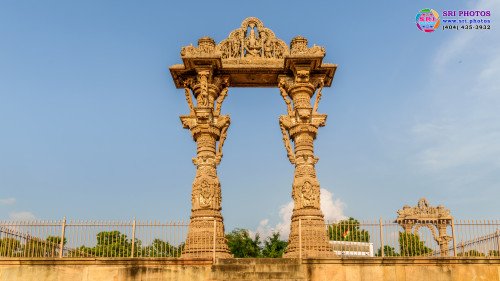
Kirti Toran, Vadnagar
The Kirti Toran (Gujarati: કીર્તિ તોરણ; literally "Arch of Glory" or "Victory Arch") refers to a pair of ornate ceremonial gateways located in Vadnagar, Mehsana district, Gujarat, India. Standing majestically on the western bank of Sharmistha Talav (Sharmistha Lake), just north of the ancient walled town and accessible via the road descending from Arjun Bari, these 12th-century structures are among the finest surviving examples of Māru-Gurjara (Solanki) architecture. Constructed from contrasting red and yellow sandstone, the eastern toran is in better preservation and has been adopted as an iconic symbol of Gujarat's cultural heritage in recent times.
Historical Importance
Vadnagar, an ancient continuously inhabited settlement with layers from the Mauryan period onward, flourished under the Solanki (Chaulukya) dynasty (10th–13th centuries CE), renowned for temple-building and patronage of the arts. The Kirti Torans date to the 12th century, likely during the reign of kings such as Siddharaja Jaysinh or Kumarapala, great patrons of architecture and Jainism/Hinduism. These gateways were probably erected as triumphal arches (kirti meaning "fame" or "glory") to commemorate military victories—possibly over the Malwa region—or as ceremonial entrances to a now-lost temple complex, perhaps dedicated to Lord Vishnu. They represent a once-common feature of medieval Gujarati urban planning: monumental toranas marking sacred or royal precincts. The pair survived invasions, shifts in rule (from Solankis to Delhi Sultanate, Mughals, and later princely states), and time, though the western one is more weathered. The eastern toran gained modern prominence as Gujarat's emblematic monument, featured in tourism campaigns and state symbolism. Vadnagar's broader heritage—including its ancient lake, fort walls, hatheli (handprint) shrines, and birthplace associations with notable figures—further elevates the site's significance.
Architectural Significance
The Kirti Torans exemplify the Māru-Gurjara style, characterized by intricate stone carving, slender proportions, and decorative exuberance typical of Solanki-era Gujarat (comparable to the Sun Temple at Modhera, Rani ki Vav at Patan, and Rudra Mahalaya at Sidhpur). Each toran consists of two tall, freestanding columns (approximately 40 feet high) supporting a richly carved architrave and crossbeam. The structures are built without mortar, relying on precise interlocking joints. Key features include:
Materials and Form: Alternating red and yellow sandstone creates striking visual contrast; the columns are octagonal or polygonal at the base, transitioning to square sections with bracket capitals.
Carvings: The surfaces are profusely embellished with battle and hunting scenes (warriors on horseback, archers, elephants in combat), floral scrolls, mythological figures (celestial beings, makaras, elephants), and narrative panels possibly depicting royal processions or victories. The arch features kirtimukha (glory-face) motifs, dancing figures, and geometric patterns.
Style Comparison: The carving technique and iconography closely resemble the ruined Rudra Mahalaya temple at Sidhpur, suggesting shared workshops or influences during the Solanki golden age.
The torans' open, freestanding design allowed them to serve as symbolic thresholds—evoking glory and protection—rather than functional gates, a hallmark of medieval Indian commemorative architecture.
Present Status and Visitor Experience
Protected as a Monument of National Importance by the Archaeological Survey of India (ASI), the Kirti Torans are freely accessible and maintained in an open lakeside setting. The eastern toran stands prominently, often photographed against the lake's waters and surrounding greenery, while the western one, though partially damaged, retains much of its detail. Visitors reach the site easily from Vadnagar town (a short walk or drive from the railway station or bus stand), combining it with nearby attractions like Sharmistha Talav, the ancient town walls, Sarneshwar Mahadev Temple, or the Hatkeshwar Temple. The serene lakeside location, especially at sunrise or sunset, offers dramatic views of the sandstone glowing against the water and sky. The Kirti Toran endures as a poetic remnant of Gujarat's medieval splendor—a soaring testament to Solanki artistry, martial pride, and architectural finesse. Standing sentinel over Sharmistha Lake, these victory arches whisper tales of ancient triumphs while embodying the timeless elegance of Māru-Gurjara heritage.
Photography by Suresh K Volam | Sri Photos | https://www.sri.photos/