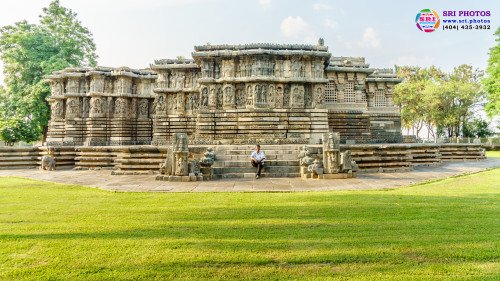
Sri Kedareswara Temple, Halebidu - Album 3
Sri Kedareswara Temple, located at Halebidu in the Hassan district of Karnataka, is a significant example of Hoysala temple architecture and represents the religious, artistic, and political achievements of the Hoysala dynasty during its mature phase. Dedicated to Lord Shiva, the temple forms part of the extensive group of medieval monuments at Halebidu, which served as the imperial capital of the Hoysalas between the 11th and 14th centuries CE. Though less prominent than the nearby Hoysaleswara Temple, the Kedareswara Temple is notable for its architectural refinement, iconographic richness, and epigraphical value.
Historical Background
Halebidu, historically known as Dwarasamudra, emerged as the Hoysala capital under King Vishnuvardhana in the early 12th century CE. The Kedareswara Temple is generally dated to the late 12th or early 13th century CE, a period marked by political consolidation and artistic patronage under rulers such as Veera Ballala II. Inscriptions found in and around the temple complex suggest royal and noble sponsorship, reflecting the close association between temple construction and state authority in the Hoysala period. The temple was constructed during a time when the Hoysalas had established dominance over much of present-day southern Karnataka, following prolonged conflicts with the Chalukyas of Kalyani and later interactions with the Seuna Yadavas and the Pandya rulers. Temple building served not only religious purposes but also functioned as a display of imperial legitimacy, economic prosperity, and cultural sophistication.
Religious Significance
The temple is dedicated to Kedareswara, a form of Shiva associated with the sacred Himalayan shrine of Kedarnath. The adoption of this name indicates the integration of pan-Indian Shaiva traditions into the regional religious landscape of Karnataka. Shaivism held a prominent position in Hoysala religious life, coexisting with Vaishnavism and Jainism, all of which received royal patronage. The presence of subsidiary shrines and iconographic representations of multiple deities within the complex reflects the inclusive nature of Hoysala religious practice. Ritual worship, land grants, and temple endowments recorded in inscriptions demonstrate that the temple functioned as an active religious and economic institution.
Architectural Layout
The Kedareswara Temple follows the Hoysala trikuta (three-shrine) plan, though only one shrine is dominant in its current state. The temple is constructed on a stellate (star-shaped) jagati, a raised platform that is characteristic of mature Hoysala architecture. This platform serves both ritual and architectural purposes, allowing circumambulation (pradakshina) and enhancing the visual complexity of the structure. The temple comprises the following main architectural components:
01. Garbhagriha (sanctum)
02. Sukhanasi (vestibule)
03. Navaranga (pillared hall)
04. Jagati (platform)
The overall orientation is east-facing, consistent with Shaiva temple conventions.
Sanctum and Superstructure
The garbhagriha houses a Shiva linga and is relatively simple in comparison to the highly ornate exterior walls. The sanctum was originally crowned by a shikhara (tower) in the Hoysala style, though this superstructure is either partially lost or reconstructed. The sukhanasi, often referred to as the “nose” of the tower, extends from the sanctum and bears decorative motifs aligned with the main tower. Unlike the towering vimanas of Dravidian temples, Hoysala shikharas are comparatively modest in height, emphasizing horizontal articulation and sculptural detail over vertical scale.
Navaranga and Pillars
The navaranga, or central hall, is one of the most architecturally refined sections of the temple. It contains lathe-turned pillars, a hallmark of Hoysala craftsmanship. These pillars are symmetrical, highly polished, and vary in design, demonstrating advanced stone-turning techniques. The ceiling panels of the navaranga are elaborately carved with geometric patterns, lotus medallions, and mythological themes. The precision and uniformity of these carvings indicate the use of standardized architectural measurements and highly skilled artisan guilds.
Exterior Sculpture and Ornamentation
The outer walls of the Kedareswara Temple are richly decorated with horizontal friezes, arranged in multiple registers. These friezes depict:
- Processions of elephants symbolizing strength and stability
- Lions representing valor
- Horses indicating mobility and warfare
- Floral and geometric patterns
- Narrative scenes from Hindu epics such as the Ramayana and Mahabharata
Above the friezes are intricately carved niches containing sculptural panels of Shaiva, Vaishnava, and Shakta deities, including Shiva in various forms, Vishnu avatars, Durga, and attendant figures. The sculptures exhibit dynamic postures, elaborate jewelry, and finely detailed facial expressions.
Material and Construction Technique
The temple is constructed primarily from chloritic schist (soapstone), a material favored by Hoysala builders for its softness when quarried and durability once exposed to air. This stone allowed for exceptionally detailed carving, contributing to the ornate aesthetic of Hoysala temples. The precision of joints, absence of mortar, and seamless integration of sculptural and structural elements reflect a high degree of technical sophistication. The uniformity of decorative motifs across different architectural components suggests centralized planning and coordinated execution.
Inscriptions and Epigraphy
Several inscriptions associated with the Kedareswara Temple provide valuable historical information regarding patronage, land grants, and religious practices. These inscriptions, written in Kannada and Sanskrit, mention donors ranging from royal officials to local elites. They also reference temple rituals, festivals, and administrative arrangements, shedding light on the socio-economic role of the temple within the Hoysala state.
Cultural and Historical Importance
Although overshadowed by the larger Hoysaleswara Temple, the Kedareswara Temple is an important contributor to the architectural ensemble of Halebidu. It exemplifies the mature Hoysala style, characterized by structural balance, sculptural abundance, and religious inclusivity. The temple also reflects the decentralization of religious patronage during the later Hoysala period, when multiple shrines were constructed within the capital to serve different communities and sects.
Conservation and Present Status
Today, the Kedareswara Temple is maintained by the Archaeological Survey of India (ASI) as part of the protected monuments at Halebidu. While certain portions have suffered damage due to historical invasions and natural weathering, much of the sculptural detail remains intact. Conservation efforts focus on structural stability and preservation of carvings. It stands as a refined example of Hoysala architectural and artistic achievement. Through its balanced layout, intricate sculpture, and historical inscriptions, the temple offers valuable insight into the religious life, political authority, and aesthetic values of the Hoysala dynasty. As part of the broader monumental landscape of Halebidu, it continues to hold significance as both a cultural heritage site and a testament to medieval South Indian temple architecture.
Photography by Suresh K Volam | Sri Photos: https://www.sri.photos/