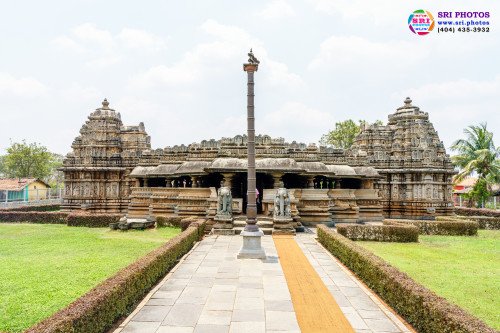
Veera Narayana Temple, Belavadi
The Veera Narayana Temple (also known as Viranarayana Temple; Kannada: ವೀರ ನಾರಾಯಣ ದೇವಾಲಯ), located in the small village of Belavadi in Chikkamagaluru district, Karnataka, India, is a magnificent triple-shrined (trikuta) Hindu temple exemplifying the grandeur of Hoysala architecture. Completed around 1200 CE during the reign of Hoysala king Veera Ballala II, the temple is built primarily of soapstone and stands as one of the largest and best-preserved Hoysala monuments. Situated 11 km north of Halebidu, 29 km southeast of Chikmagalur, and about 40 km north of Hassan, Belavadi (ancient Ekachakranagara) lies in a serene rural setting amid lush greenery.
The temple is dedicated to three forms of Lord Vishnu: the central east-facing shrine to Veera Narayana (a standing four-armed form of Narayana on a lotus pedestal), the north-facing shrine to Venugopala (Krishna playing the flute), and the south-facing shrine to Yoga-Narasimha (Narasimha in a yogic posture). It is renowned for its architectural scale and harmony rather than the minute intricate sculptures seen in Belur or Halebidu.
Historical Importance
Belavadi holds mythological significance as Ekachakranagara from the Mahabharata, where Pandava prince Bhima slew the demon Bakasura to protect the villagers. The temple's construction began in stages, with the oldest Veera Narayana shrine likely completed first around 1200 CE (some sources suggest an earlier phase under Vishnuvardhana in 1117 CE), followed by expansions adding the large ranga-mandapa and the other two shrines by about 1206 CE or shortly thereafter. The project reflects the Hoysalas' Vaishnava patronage during a period of religious tolerance.
The temple suffered damage during the 14th-century invasions but was partially fortified and has remained remarkably intact. It escaped the extensive destruction that affected many Hoysala sites, preserving its original features. Since 1760, it has been under the patronage of the Sringeri Mutt, with rituals performed according to Vaikhanasa Agama Shastras.
Architectural Significance
The Veera Narayana Temple is a trikuta structure with three complete vimanas (superstructures) in the Vesara style, characterized by ornate, jewelry-like detailing, miniature decorative towers, and kalasha finials. The temple measures approximately 65–90 meters in length (including the entrance) and features a unique layout: two closed mantapas (one with 13 bays, another with 9) connected to an exceptionally large open ranga-mandapa (103 feet wide with 37 bays), supported by a total of around 108 lathe-turned, bell-shaped pillars—many polished to a jewel-like sheen and uniquely carved.
The outer walls follow an "old style" Hoysala pattern with eaves, running pilasters, and friezes of Hindu deities, attendants, and mythological figures. The newer shrines are square or stellate on plan, with bold exterior carvings visible from afar, including standout reliefs of Krishna dancing on the serpent Kaliya and Garuda. The ceilings display unusual figural tableaux depicting Krishna legends, while interiors boast deep lotus motifs and geometric designs. A remarkable phenomenon occurs annually on March 23 (equinox day), when morning sunlight passes through seven doorways to illuminate the Veera Narayana idol in the central sanctum—a testament to the builders' precise astronomical and architectural knowledge.
Present Status and Visitor Experience
Protected as a Monument of National Importance by the Archaeological Survey of India (Bengaluru Circle), the temple remains an active place of worship with daily rituals, abhishekam on special nakshatras, and festivals. It is open daily from approximately 8:00 AM to 2:00 PM and 4:00 PM to 7:30 PM. Visitors enter through a gateway flanked by massive stone elephants, stepping into a vast pillared hall that evokes awe with its scale and symmetry.
The serene rural ambiance, combined with the temple's imposing yet elegant proportions, offers a peaceful contrast to the more crowded Belur and Halebidu sites. The complex includes a well-maintained courtyard and nearby shrines, making it ideal for quiet contemplation and photography.
The Veera Narayana Temple at Belavadi endures as a hidden gem of Hoysala heritage—a monumental expression of architectural ambition and spiritual devotion, where vast pillared spaces, exquisite towers, and precise cosmic alignment converge in timeless harmony.
Photography by Suresh K Volam | Sri Photos: https://www.sri.photos/