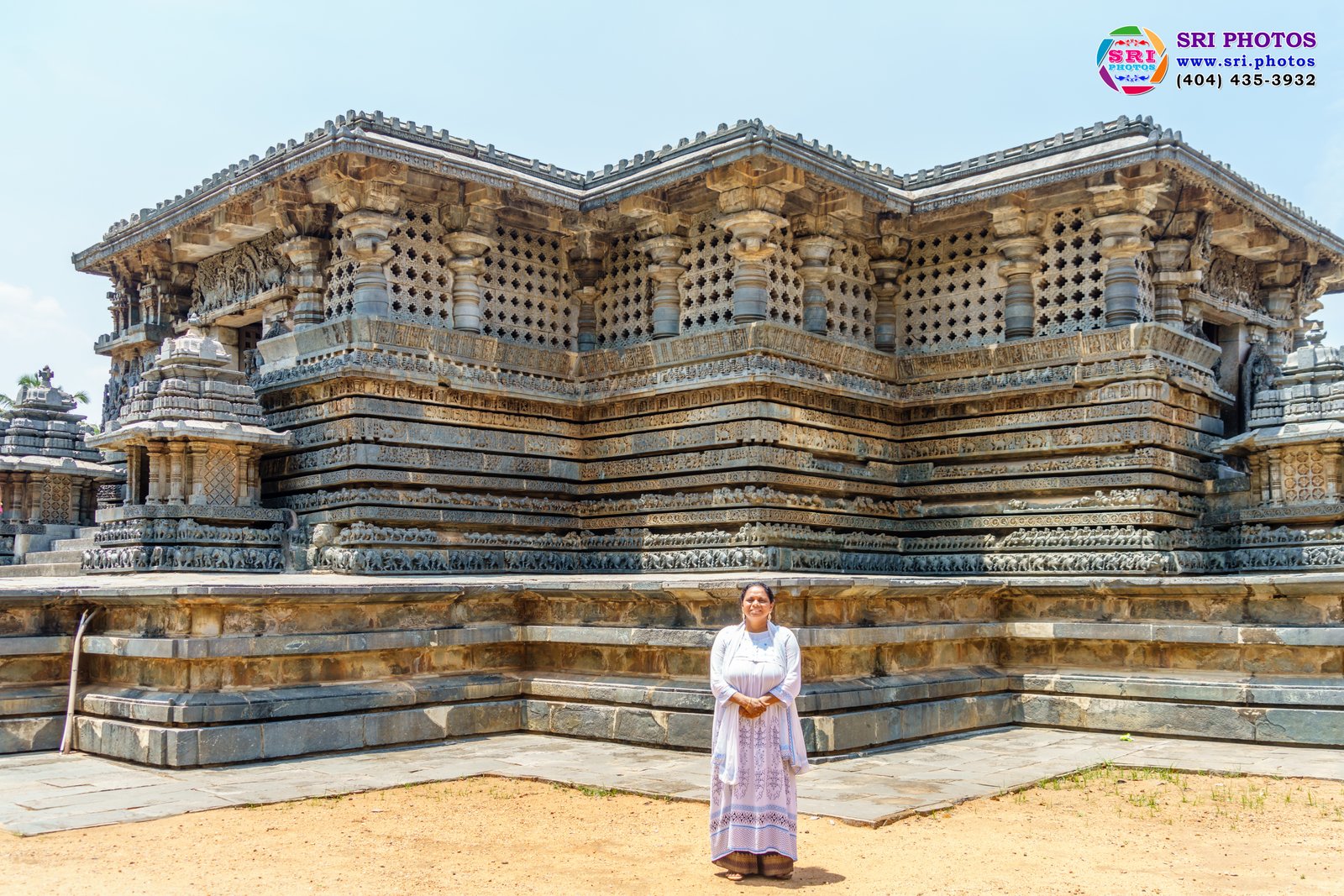
Hoysaleswara Temple, Halebidu - Album 3
Historical Context
The Hoysaleswara Temple in Halebidu, Karnataka, is a monumental relic of the Hoysala Empire, constructed between 1121 CE and 1160 CE under King Vishnuvardhana. Located in Dwarasamudra, the Hoysala capital, the temple reflects the dynasty’s cultural and political zenith. Dedicated to Lord Shiva, it was patronized by Vishnuvardhana and Queen Shantala Devi, whose contributions are documented in Kannada and Sanskrit inscriptions. The temple, a proposed UNESCO World Heritage Site, survived 14th-century invasions by the Delhi Sultanate, though its gopurams were lost.
Rise of the Hoysalas
The Hoysala Empire, emerging in the 11th century, grew under Vishnuvardhana, who expanded its territories and shifted patronage from Jainism to Vaishnavism and Shaivism. The temple’s construction marked Dwarasamudra’s establishment as the capital, replacing Belur. Inscriptions detail endowments of gold, land, and villages, with merchants and artisans contributing significantly. The temple served as a socio-economic hub, supporting mathas (monasteries) and agrahara (scholarly settlements).
Impact of Invasions
In 1311 CE, Malik Kafur’s invasion devastated Dwarasamudra, damaging the temple’s outer structures. Despite this, the core sanctums and carvings endured, a testament to Hoysala engineering. The capital’s decline followed, with Halebidu abandoned by the 14th century, but the temple’s religious significance persisted, maintained by local communities until the ASI took over in the 19th century.
Architectural Highlights
The dvikuta temple, built on a stellate platform, features two sanctums for Hoysaleswara and Shantaleswara, each with a Shiva Lingam. The exterior boasts 1,000 friezes, depicting elephants, lions, mythological scenes, and deities, while the interior mandapa showcases lathe-turned pillars and ornate ceilings. Two 9-foot Nandi statues guard the entrance, reflecting Hoysala artistry. Jain influences, inspired by Shantala Devi, are evident in Tirthankara carvings.
Modern Relevance
The temple remains an active worship site, with rituals like abhishekam and festivals like Kartika Purnima. The ASI-managed museum displays artifacts, including bronze idols and inscriptions. The temple’s historical significance attracts scholars studying medieval Indian polity and art.
Visitor Information
Accessible 31 km from Hassan, the temple is open from 6:30 AM to 9:00 PM. Visitors should explore early mornings for crowd-free views and cooler weather, with guided tours available for historical insights.
Photography by Suresh K Volam | Sri Photos | https://www.sri.photos/