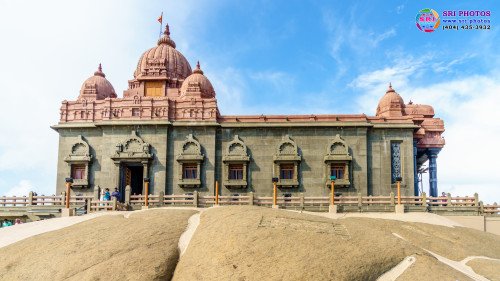
Vivekananda Rock Memorial, Kanyakumari
The Vivekananda Rock Memorial (Tamil: விவேகானந்தர் பாறை நினைவிடம்) is a prominent monument and major tourist attraction situated on one of two mid-sea rocks about 500 metres off the mainland of Vavathurai in Kanyakumari, Tamil Nadu, India—the southernmost tip of the Indian subcontinent. Inaugurated on 2 September 1970, the memorial honours Swami Vivekananda, the 19th-century Hindu monk and philosopher, who is believed to have meditated on this rock for three days (25–27 December 1892) and attained spiritual enlightenment, crystallising his vision for India's future and the famous Kanyakumari Resolve. The site also holds ancient religious significance, as legends describe it as Shripada Parai, where Goddess Kanyakumari (a form of Parvati) performed intense tapas (austerity) standing on one foot in devotion to Lord Shiva, leaving an imprint of her sacred foot (Shripadam).
Historical Importance
In December 1892, shortly before his historic speech at the Parliament of the World's Religions in Chicago (1893), Swami Vivekananda reached Kanyakumari after wandering across India. He swam to the isolated rock amid the confluence of the Bay of Bengal, Arabian Sea, and Indian Ocean, meditating there for three days and nights. This experience inspired his resolve to dedicate his life to the upliftment of India's masses, blending spiritual awakening with national service.
The idea for a memorial emerged in 1962 during Vivekananda's birth centenary celebrations. A committee formed, but faced opposition from local Christian fishermen who claimed the rock as "Kurusu Paarai" (Cross Rock). After protests and a government inquiry, the rock was officially recognised as Vivekananda Rock in 1963. Construction began in 1964 under the leadership of Eknath Ranade, a dedicated RSS pracharak and social activist, who mobilised a nationwide campaign. Despite initial government resistance, Ranade secured approvals through persistent efforts, including collecting signatures from 323 Members of Parliament and gaining support from Prime Minister Jawaharlal Nehru and Tamil Nadu Chief Minister M. Bhaktavatsalam. The project, completed in six years, was funded entirely through public donations from millions of Indians, symbolising national unity. Dedicated to the nation by President V.V. Giri, the memorial serves as the cornerstone for the Vivekananda Kendra (founded 1972), a spiritually oriented service organisation promoting man-making and nation-building in Vivekananda's vision.
Architectural Significance
The memorial is an architectural masterpiece blending diverse Indian temple styles—rock-cut, cathedral-like elements, and regional influences from across the country—to symbolise unity in diversity. Built primarily of blue granite from Ambasamudram (quarried 72 miles away) and other stones, it comprises two main structures aligned so that the statue of Vivekananda faces the sacred Shripadam:
- Vivekananda Mandapam: This includes the Sabha Mandapam (assembly hall with an open courtyard, corridor, and Pratima Mandapam housing a life-sized bronze statue of Vivekananda in his parivrajaka (wandering monk) pose, sculpted by Narayanrao Sonavadekar); Mukha Mandapam (porch with ornate carvings on ceilings, beams, and columns); and Dhyana Mandapam (meditation hall with six rooms for quiet reflection).
- Shripada Mandapam: A square hall built over the legendary footprint of Goddess Kanyakumari, featuring a garbha griha (sanctum), inner and outer prakarams (corridors), and an outer platform. It includes a study hall and small museum on Vivekananda's life.
The design fuses elements of West Bengal and Tamil Nadu architecture, with intricate carvings, harmonious proportions, and a serene ambiance enhanced by the surrounding sea.
Present Status and Visitor Experience
Managed by the Vivekananda Rock Memorial and Vivekananda Kendra, the site is a protected monument and active spiritual centre. Access is by ferry from the Kanyakumari jetty (tickets available online or on-site; life jackets provided). The memorial is open daily from early morning to late afternoon, with a small entry fee and separate charges for the ferry.
Visitors often combine the trip with the nearby 133-foot Thiruvalluvar Statue (dedicated to the Tamil poet-saint). The ferry ride offers stunning views of the tri-sea confluence, dramatic sunrises/sunsets, and the rock rising from the waves. Inside, the peaceful halls, meditative atmosphere, and panoramic ocean vistas create a profound sense of serenity and inspiration. The Vivekananda Rock Memorial stands as an enduring symbol of spiritual awakening, national pride, and unity—where the roar of the sea meets the silence of enlightenment, reminding visitors of Vivekananda's timeless message of strength, service, and harmony.
Photography by Suresh K Volam | Sri Photos: https://www.sri.photos/