Rudabai Stepwell (Adalaj ni Vav), Adalaj - Album 2
Adalaj Stepwell, known locally as Adalaj ni Vav (Gujarati: અડાલજની વાવ), is a magnificent five-storey subterranean water structure located in Adalaj village, Gandhinagar district, Gujarat, India, about 19 km north of Ahmedabad. Constructed in 1498 CE, this architectural masterpiece is widely regarded as one of the finest surviving examples of the Gujarati stepwell tradition. Built entirely of intricately carved sandstone, it descends 30 metres to reach groundwater and combines Hindu architectural principles with early Indo-Islamic decorative elements.
Historical Context
The stepwell was commissioned by Queen Rudabai (Rudadevi), wife of the Vaghela chief Virasimha, in memory of her husband who was killed in battle. A Sanskrit inscription on the eastern wall records the foundation in Vikram Samvat 1555 (1499 CE) and names the builders as the architects of the Vaghela court. The Vaghelas, successors to the Solanki dynasty, were Hindu rulers, and the stepwell belongs to the final phase of Hindu patronage before the region came under sustained Muslim rule. Shortly after its completion, in 1500 CE, Sultan Mahmud Begada of the Gujarat Sultanate conquered the area. Legend holds that the sultan was so impressed by the stepwell’s beauty that he ordered it preserved, despite his general policy of destroying Hindu temples and monuments. The stepwell thus survived intact through the centuries, later maintained by Mughal and Maratha administrators. It fell into disuse after the introduction of modern water supply systems in the British period but was restored in the 20th century and declared a protected monument.
Architectural Features
Adalaj Stepwell exemplifies the classic Gujarati vav design: a long descending passage with landings, leading to a deep well shaft.
01. Layout
Oriented north–south, the stepwell has three main entrances (north, south and east) that converge at the first landing. From there, a single broad staircase descends through five storeys to the well chamber. The shaft is octagonal, with a square well at the bottom. The upper levels feature pillared pavilions and balconies supported by ornate brackets.
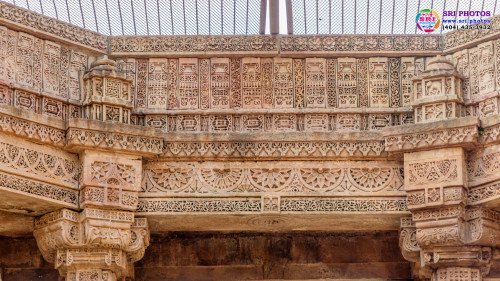
02. Carvings and Ornamentation
The walls, pillars, brackets and ceilings are covered with extraordinarily detailed reliefs. Motifs include:
- Floral scrolls, geometric patterns and jali screens
- Elephants, peacocks, parrots and mythical creatures
- Dancing figures, musicians and court scenes
- Hindu deities (Vishnu, Lakshmi, Ganesha, Navagrahas)
- Islamic-style arabesques and star patterns
The stepwell’s signature feature is its “floating” or cantilevered pillars that appear to hang without visible support, achieved through precise stone joinery.
03.Special Elements
- A small shrine to Amba Mata (Goddess) on the lowest platform
- A lotus-shaped fountain in the well chamber
- Intricate jali windows that filter light and provide ventilation
- A circular opening at the top that frames the sky, creating a dramatic shaft of light
The blend of Hindu iconography and Islamic geometric designs reflects the cultural synthesis of Gujarat in the late 15th century, a period of transition between Hindu and Muslim rule.
Present Status and Visitor Experience
Adalaj Stepwell is a Monument of National Importance under the Archaeological Survey of India and is maintained by Gujarat Tourism. The site is well-lit at night, highlighting the carvings, and a small visitor centre nearby provides information about stepwells across Gujarat. Visitors descend the cool, shaded stairs, experiencing the dramatic drop in temperature and the play of light through the jali screens. The stepwell is especially striking during the monsoon when the well fills with water, creating mirror-like reflections of the architecture. The surrounding village remains quiet and rural, preserving a sense of timelessness.
Adalaj Stepwell stands as a testament to Gujarat’s ancient tradition of water conservation and architectural excellence. Its intricate carvings, ingenious engineering and harmonious fusion of Hindu and Islamic styles make it one of the most beautiful and historically significant stepwells in India.
Photography by Suresh K Volam | Sri Photos : https://www.sri.photos