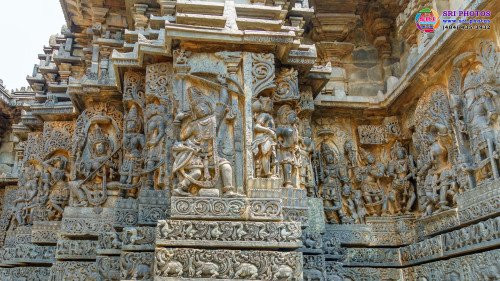
Hoysaleswara Temple, Halebidu - Album 8
The Hoysaleswara Temple (Kannada: ಹೊಯ್ಸಳೇಶ್ವರ ದೇವಾಲಯ; also spelled Hoysaleshvara or Halebidu Temple) is a 12th-century Shaiva monument located in Halebidu (ancient Dwarasamudra), Hassan district, Karnataka, India. Constructed primarily between 1121 CE and 1160 CE under the patronage of King Vishnuvardhana of the Hoysala Empire, it is the largest and most ornate temple in Halebidu, the former Hoysala capital. The temple is a dvikuta (twin-shrined) structure dedicated to Shiva, with the shrines named Hoysaleshwara (after the king) and Shantaleshwara (after Queen Shantala Devi). Along with the Chennakeshava Temple at Belur and the Keshava Temple at Somanathapura, it forms part of the Sacred Ensembles of the Hoysalas, inscribed as a UNESCO World Heritage Site in 2023.
Historical Importance
The temple was sponsored by wealthy Shaiva citizens of Dwarasamudra, including merchants Ketamalla and Kesarasetti, rather than directly by the king. Its construction paralleled the Vaishnava Chennakeshava Temple at Belur, reflecting a friendly rivalry between Shaiva and Vaishnava communities under Hoysala rule. The Hoysalas, known for religious tolerance, incorporated motifs from Vaishnavism, Shaktism and Jainism in the carvings. In the early 14th century, Halebidu was sacked twice by armies of the Delhi Sultanate (1311 and 1326 CE), leading to the temple's abandonment and partial damage. The capital was never fully rebuilt, earning the site its name "Halebidu" (old or ruined city). The temple remained incomplete—the intended towering shikharas were never added—and fell into neglect until 20th-century restorations by the Archaeological Survey of India.
Architectural Significance
The Hoysaleswara Temple is widely regarded as the pinnacle of Hoysala architecture, built in the Vesara (Karnata-Dravida) style using soft chloritic schist (soapstone), which enabled extraordinary intricacy.
01. Plan and Layout
A dvikuta temple on a jagati (star-shaped platform), with two identical east-facing shrines connected by a large open mandapa and a shared Nandi pavilion for each. The overall plan is staggered square with numerous projections, creating a dynamic silhouette.
02. Wall Articulation
The exterior walls are divided into horizontal friezes: elephants (symbolising stability), lions (courage), horses (speed), makaras (mythical creatures), floral scrolls, and narrative panels from epics. Above these are large reliefs of deities, dancers and court scenes.
03. Sculptural Excellence
Over 240 figures of Ganesha in various poses, intricate madanika (bracket figures) depicting celestial dancers, pierced stone windows (jalis), and polished lathe-turned pillars inside the mandapas. The two massive monolithic Nandi statues, richly ornamented, face their respective lingas.
04. Interior Features
The ceilings display deep lotus pendants and geometric designs, while doorways are multi-layered with scrollwork and guardian figures.
Present Status
Protected as a Monument of National Importance by the Archaeological Survey of India, the temple complex includes an on-site museum housing Hoysala sculptures. It remains a living shrine with daily worship, though the primary attraction is its architectural grandeur. An archaeological park surrounds the site, with nearby Jain basadis and the smaller Kedareshwara Temple. The Hoysaleswara Temple endures as the supreme expression of Hoysala artistry—a vast open-air gallery of stone where every surface tells a story of devotion, mythology and unparalleled craftsmanship, often called the "climax of Indian temple sculpture."
Photography by Suresh K Volam | Sri Photos : https://www.sri.photos