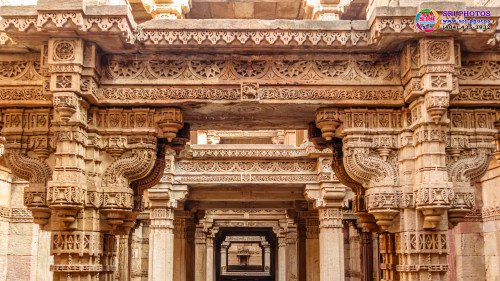
Rudabai Stepwell (Adalaj ni Vav), Adalaj
The Adalaj Stepwell (Gujarati: અડાલજની વાવ; also known as Rudabai Vav) is one of the finest and best-preserved stepwells in Gujarat, located in Adalaj village, 19 km north of Ahmedabad in Gandhinagar district, Gujarat, India. Built in 1498 CE during the reign of the Vaghela dynasty, this five-storey subterranean structure is celebrated for its exquisite Indo-Islamic architecture, intricate stone carvings and ingenious engineering. The stepwell served as a vital water source for the arid region and as a social and religious gathering place.
Historical Importance
The stepwell was commissioned by Queen Rudabai (or Rudadevi), wife of Vaghela chief Virasimha, in memory of her husband, who died in battle. An inscription in Sanskrit on the eastern wall records the date of construction as Vikram Samvat 1555 (1499 CE) and mentions the patronage of the Vaghela rulers of Dholka. The Vaghelas, who succeeded the Solanki dynasty, were Hindu rulers, and the stepwell reflects the continuity of Gujarat’s rich tradition of water architecture even after the region came under Muslim rule shortly thereafter. In 1500 CE, Sultan Mahmud Begada of the Gujarat Sultanate captured the area and is said to have admired the stepwell so much that he ordered it to remain intact, despite his general policy of destroying Hindu monuments. The stepwell thus survived the turbulent period of the 16th century and was later maintained by the Mughals and Marathas. It fell into disuse after the British introduced piped water systems in the 19th century but was restored and declared a protected monument in the 20th century.
Architectural Significance
Adalaj Stepwell is a classic example of the Gujarati stepwell (vav) type, combining Hindu architectural elements with early Indo-Islamic decorative motifs.
01. Plan and Structure
The stepwell is oriented north-south, descending through five storeys to a depth of about 30 metres. The main shaft is octagonal, with three entrances (north, south and east) connected by flights of steps leading to a large rectangular well shaft. The lowest level holds the water, while the upper storeys feature pillared pavilions and balconies.
02. Decorative Features
The walls, pillars and brackets are covered with intricate carvings in sandstone. Motifs include:
- Floral and geometric patterns
- Dancing figures, musicians and mythological scenes
- Elephants, peacocks, parrots and other animals
- Hindu deities such as Vishnu, Lakshmi, Ganesha and the Navagrahas
- Islamic geometric arabesques and jali screens
A notable feature is the three-dimensional “hanging” pillars that appear to float, achieved through precise stone jointing.
03. Unique Elements
- A small shrine to Amba Mata (Goddess) on the lowest platform
- A well chamber with a lotus-shaped fountain
- Intricate jali windows that allow light and air while maintaining privacy
- A small pavilion on the top level with a circular opening that frames the sky
The combination of Hindu iconography and Islamic geometric patterns reflects the cultural synthesis of late 15th-century Gujarat, a period when Hindu and Muslim traditions coexisted and influenced each other.
Present Status and Visitor Experience
Adalaj Stepwell is protected as a Monument of National Importance by the Archaeological Survey of India and maintained by the Gujarat Tourism Department. The site is well-lit with subtle lighting that highlights the carvings at night, and a small museum nearby displays photographs and models of other stepwells. Visitors descend the steps to experience the cool, shaded interior and marvel at the play of light through the jali screens. The stepwell is especially beautiful during the monsoon when the well fills with water, creating a mirror-like reflection of the architecture. The surrounding village remains rural, with a peaceful atmosphere despite its proximity to Ahmedabad.
The Adalaj Stepwell is a masterpiece of water architecture and a symbol of Gujarat’s enduring tradition of ingenuity in water conservation. Its delicate carvings, multi-level design and harmonious blend of Hindu and Islamic styles make it one of the most architecturally significant and visually stunning stepwells in India.
Photography by Suresh K Volam | Sri Photos : https://www.sri.photos