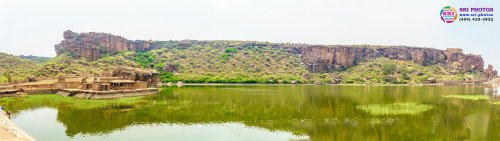
Bhootanatha Temple, Badami
The Bhootanatha Temple (also spelled Bhutanatha or Bhooteshwara Temple) is a finely preserved early Chalukya temple complex located on the eastern bank of the Agastya Tirtha lake (also known as the Agni Tirtha) in Badami, Bagalkot district, Karnataka, India. Situated at the northern end of the town, it forms a picturesque ensemble with two main temples—the older Bhootanatha I (c. 6th–7th century CE) and the larger Bhootanatha II (c. 8th century CE)—along with several smaller shrines and a ruined Nandi pavilion. The complex is one of the most scenic and serene sites in Badami, its red sandstone walls and towers reflected in the lake waters, especially at sunrise and sunset.
Historical Importance
Badami was the capital of the Early Chalukyas (Western Chalukyas) from the mid-6th century CE under Pulakeshin I. The Bhootanatha temples were built during the reigns of Mangalesha (r. 597–609 CE) and Vikramaditya II (r. 733–746 CE), though exact dates are not recorded. The site is dedicated to Shiva as Bhootanatha (Lord of Spirits or Ghosts), a fierce yet protective form associated with cremation grounds and the dissolution of life. The temple’s location beside the sacred Agastya Tirtha—where legend says the sage Agastya performed penance and drank the ocean—made it a major pilgrimage centre. The complex escaped large-scale destruction during later invasions and remained a living shrine, with daily worship continuing to the present. Inscriptions found nearby, including those of Mangalesha and Vikramaditya II, confirm the Chalukyas’ devotion to Shaivism alongside Vaishnavism and Jainism. The Bhootanatha temples represent the culmination of the early Chalukya structural style before the grander experiments at Pattadakal.
Architectural Significance
The Bhootanatha complex showcases the evolution of Chalukyan architecture from simple flat-roofed prototypes to the more elaborate Dravida-style temples of the 8th century.
Bhootanatha I (Older Temple)
This smaller, earlier structure (late 6th or early 7th century) is a simple square garbhagriha with a flat roof and a small porch. Its walls are plain except for pilasters and a simple kapota (cornice) moulding. The sanctum houses a Shiva linga, and the temple is believed to be the oldest surviving structural shrine in Badami.
Bhootanatha II (Main Temple)
Built around the 8th century, this is a more developed Dravida-style temple with a taller vimana (tower), a larger garbhagriha, an antarala (vestibule) and a pillared mandapa. The vimana is a three-tiered pyramidal structure with kuta-sala elements and miniature aedicules typical of early Chalukyan Dravida. The temple’s exterior walls are adorned with shallow pilasters, niches and floral motifs. The mandapa has a central ceiling panel carved with a large lotus medallion surrounded by eight directional guardians (ashtadikpalakas). The doorjambs are richly decorated with Ganga-Yamuna figures, mithuna couples and floral scrolls.
Additional shrines and features
A smaller subsidiary shrine to the south houses a large Nandi bull facing the main temple. A ruined pavilion with lathe-turned pillars and a small shrine to Saptamatrikas (seven mothers) lie to the north. The entire complex rests on a high moulded basement with elephant and lion friezes.
The temples are built of locally quarried red sandstone, the same material used for Badami’s famous cave temples and the fort above. The carvings, though less elaborate than those at Pattadakal, are crisp and expressive, with a restrained elegance characteristic of the early Chalukyan school.
Sculptural Highlights
- The main garbhagriha contains a Shiva linga with a small Nandi in the mandapa.
- Wall niches feature Shiva in various forms, including Nataraja, Ardhanarishvara and Bhootanatha himself.
- The doorways display finely carved dwarapalas (guardians) and Gaja-Lakshmi figures.
- Ceiling panels include lotus motifs and dancing figures, reflecting the Chalukyan love for symmetry and grace.
Present Status and Visitor Experience
The Bhootanatha Temple is protected as a Monument of National Importance by the Archaeological Survey of India. The main temple remains active, with daily rituals performed by local priests. The complex is especially beautiful in the early morning, when the golden light of sunrise bathes the sandstone and the lake mirrors the towers. Visitors often combine a visit to Bhootanatha with the nearby Badami cave temples, Agastya Tirtha lake and the fort. The site is less crowded than Pattadakal or Aihole, offering a tranquil setting for photography, meditation and quiet exploration. The Bhootanatha Temple stands as a poetic counterpoint to the grandeur of Pattadakal and the experimentation of Aihole. Its modest scale, elegant proportions and lakeside setting make it one of the most visually striking and spiritually evocative monuments of the Early Chalukyas—a quiet masterpiece where architecture, nature and devotion converge.
Photography by Suresh K Volam | Sri Photos : https://www.sri.photos