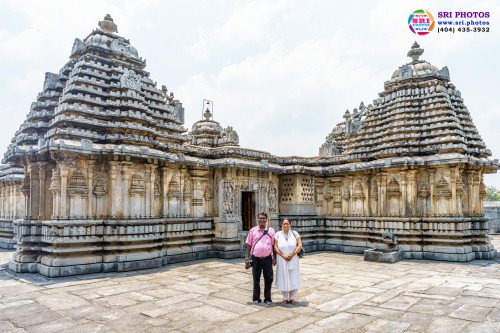
Lakshmi Devi Temple, Doddagaddavalli
The Lakshmi Devi Temple at Doddagaddavalli (Kannada: ದೊಡ್ಡಗದ್ದವಳ್ಳಿ ಲಕ್ಷ್ಮೀದೇವಿ ದೇವಾಲಯ) is a finely preserved early Hoysala temple located 16 km south-east of Hassan city in Hassan district, Karnataka, India. Built in 1114 CE during the reign of King Vishnuvardhana (r. 1108–1152 CE), it is the oldest surviving complete Hoysala monument and one of the earliest temples dedicated primarily to Lakshmi (Vaishnava consort) rather than Shiva or Vishnu. The temple stands in the quiet village of Doddagaddavalli on the northern bank of an ancient irrigation tank (kalyani) and remains an active place of worship managed by the Muzrai Department of Karnataka.
Historical Importance
The temple was commissioned in 1114 CE by a wealthy merchant named Kullahana Rahuta and his wife Sahaja Devi, as recorded in a detailed old-Kannada inscription on a beam inside the mahamantapa. This makes Doddagaddavalli one of the best-dated early Hoysala structures. King Vishnuvardhana, though originally a Jain who converted to Vaishnavism under the influence of Ramanujacharya, liberally patronised Shaivism, Vaishnavism and Jainism. The temple thus belongs to the crucial transitional decade (1110–1120 CE) when Hoysala architecture moved from simple, modest structures under the Western Gangas and early Hoysalas to the highly ornate style that reached perfection at Belur and Halebidu a century later.
The presence of four shrines in one complex (chatushkuta) dedicated to Lakshmi, Kali, Shiva and Bhairava reflects the religious syncretism encouraged by Vishnuvardhana and his queen Shantala Devi. The temple escaped destruction during the 14th-century Islamic invasions that damaged many Hoysala monuments, remaining virtually unaltered except for minor later repairs.
Architectural Significance
Doddagaddavalli is the earliest known example of the fully developed Hoysala four-shrined (chatushkuta) plan on a staggered square layout, a design repeated in later masterpieces such as the Lakshminarasimha Temple at Nuggehalli and the Someshwara Temple at Haranhalli.
Key features include:
- Plan and layout Four vimanas (towers) are placed at the four corners of a square cella, connected by a common closed mahamantapa and a smaller open porch (mukhamantapa) on the east. The central bay of the mahamantapa originally carried a larger fifth tower (now lost). The entire structure rests on a high moulded basement (adhisthana) with miniature friezes of elephants, horses, lions and makaras.
- Stellate (star-shaped) plan Each of the four shrines is 16-pointed stellate (star-shaped) on plan, the earliest surviving use of this signature Hoysala feature. The walls are broken into numerous angled projections and recesses, creating dramatic light-and-shadow effects.
- Towers (shikharas) The original kadamba-nagara (stepped pyramidal) towers survive intact on the Lakshmi and Kali shrines; those on the Shiva and Bhairava shrines were rebuilt in brick and plaster in later centuries. The surviving towers display miniature aedicules and kuta-sala elements characteristic of early Hoysala Vesara style.
- Sculpture and ornamentation Though simpler than later Hoysala temples, the wall surfaces are already covered with finely carved pilasters, niches and friezes. The doorways of the four garbhagrihas are exceptionally ornate, with five sakhas (jambs) carrying scrollwork, creepers and mithunas). The lintel of the Lakshmi shrine shows Lakshmi flanked by elephants (Gaja-Lakshmi). Notable images include an eight-armed Kali dancing on Ganesh, Bhairava with his dog vehicle, and Bootha-Vishnu (a rare Hoysala form). The ceiling of the mahamantapa contains a magnificent lotus with multiple layers of petals and intricate perforations.
- Additional structures A rare separate shrine to Parvati (Gauri) stands to the north-east of the main temple, containing a beautifully carved image of Mahishasuramardini. A small Nandi-mantapa faces the Shiva shrine.
The temple is built entirely of soapstone (chloritic schist), the material that allowed the Hoysalas their extraordinary delicacy of carving in later decades.
Present Status
The Lakshmi Devi Temple is protected as a Monument of National Importance by the Archaeological Survey of India while daily rituals are performed by hereditary priests. The surrounding tank and village retain a peaceful rural atmosphere, with the temple reflected in the water during monsoon months. The site receives moderate numbers of visitors, mostly architecture students and devotees during Lakshmi puja and Deepavali.
Doddagaddavalli stands as a quiet milestone: the moment when Hoysala builders first mastered the stellate plan, refined miniature wall articulation, and achieved a perfect balance between structural logic and sculptural exuberance that would define Karnataka temple architecture for the next two centuries.
Photography by Suresh K Volam | Sri Photos : https//www.sri.photos