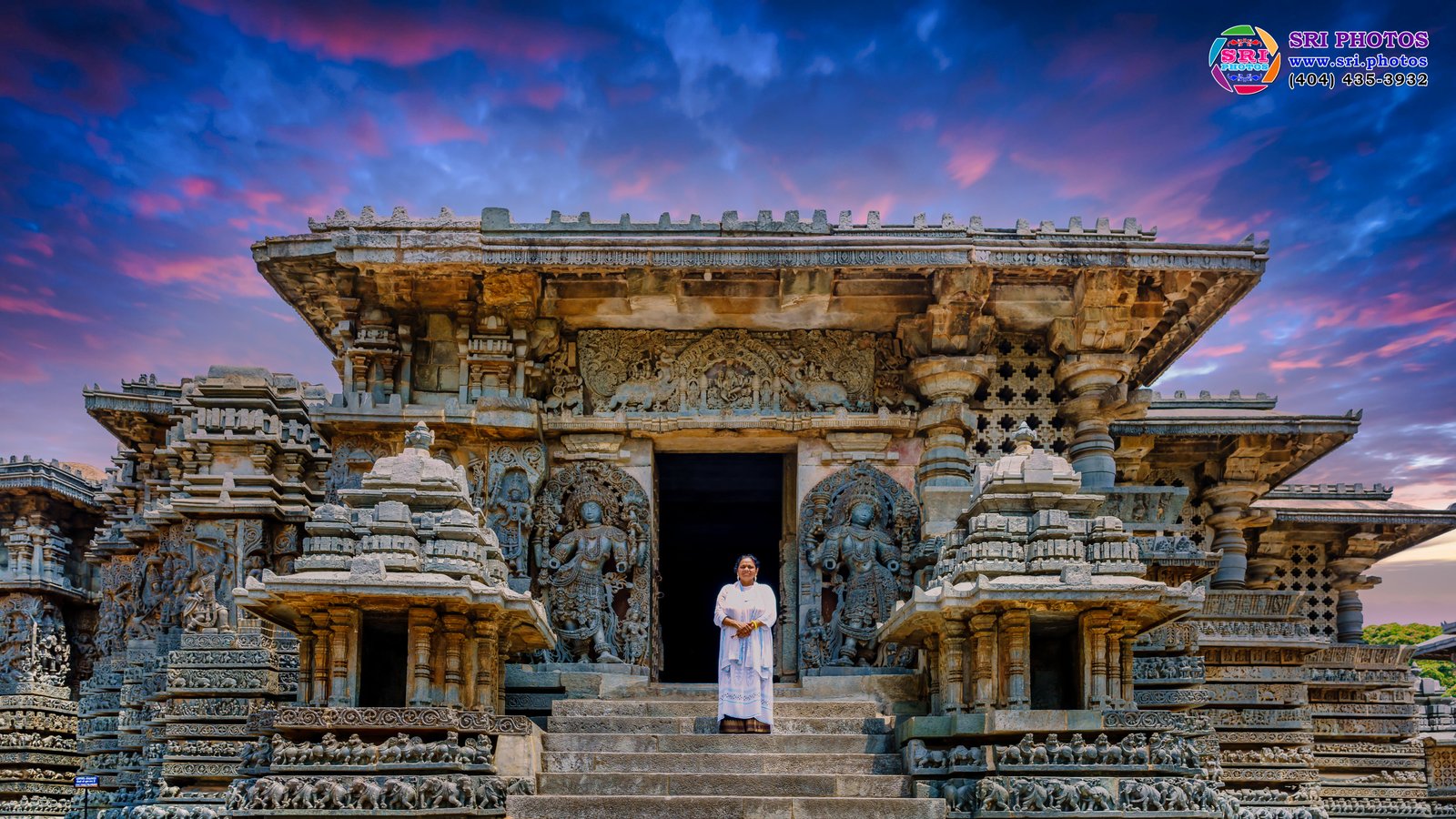
Hoysaleswara Temple, Halebidu - Album 2
An Architectural Marvel
The Hoysaleswara Temple in Halebidu, Karnataka, India, stands as a pinnacle of Hoysala architecture, renowned for its intricate soapstone carvings and stellate design. Constructed between 1121 CE and 1160 CE during the reign of King Vishnuvardhana, this twin-shrined temple dedicated to Lord Shiva is a proposed UNESCO World Heritage Site. Located in the former Hoysala capital of Dwarasamudra, the temple exemplifies the dynasty’s architectural innovation and artistic excellence, despite partial damage from 14th-century invasions by the Delhi Sultanate.
Architectural Design
The Hoysaleswara Temple is built on a stellate (star-shaped) platform, a hallmark of Hoysala architecture, measuring approximately one meter high and featuring 32 angles. Constructed from chloritic schist (soapstone), the temple’s soft stone enabled artisans to carve intricate details that hardened over time. The temple spans 105 meters in length, 64 meters in width, and 9 meters in height, making it one of the largest Hoysala temples. Its dvikuta (twin-shrined) structure houses two sanctums, dedicated to Shiva as Hoysaleswara and Shantaleswara, named after Vishnuvardhana and his queen, Shantala Devi. Each sanctum contains a Shiva Lingam, connected by a shared navaranga (pillared hall).
The exterior walls are adorned with eight horizontal friezes, a sculptural masterpiece comprising over 1,000 reliefs. The lowest frieze depicts elephants in dynamic poses, symbolizing strength, followed by lions for courage, scrollwork with floral motifs, horses representing military might, birds, mythological scenes, dancers, and subtle erotic motifs. Above these, 340 large panels feature Hindu deities such as Shiva, Vishnu, Durga, and Ganesha, alongside celestial beings like apsaras and gandharvas. Notable sculptures include Shiva as Nataraja and Gajasurasamhara. The upper walls are punctuated by miniature towers (aediculae), adding vertical rhythm to the design.
The interior mandapa features lathe-turned pillars, each uniquely carved with geometric and floral patterns. The ceiling panels depict Shiva, Parvati, and other deities in high relief, showcasing three-dimensional artistry. Two massive Nandi statues, each 9 feet long and 7 feet high, carved from single soapstone blocks, guard the eastern entrance, their polished surfaces reflecting Hoysala craftsmanship. The absence of towering gopurams, likely destroyed during invasions, is mitigated by two modest entrance porches supported by intricately carved pillars.
Construction Techniques
The temple’s construction involved advanced engineering, with artisans organized into guilds under master sculptors like Ketana and Malithamma, whose signatures appear on carvings. Soapstone was sourced from local quarries, carved in situ using scaffolding for higher sections. The stellate platform required precise mathematical planning for stability, while lathe-turned pillars were crafted with rudimentary tools, a technique unique to the Hoysalas. Inscriptions record royal and merchant funding, with artisans receiving land grants for their work.
Cultural Significance
The Hoysaleswara Temple served as a religious and cultural hub, hosting rituals, performances, and royal ceremonies. Its pluralistic iconography, including Jain motifs influenced by Queen Shantala Devi, reflects the Hoysalas’ inclusive patronage. Today, the temple remains active, with daily rituals and festivals like Maha Shivratri drawing devotees. Managed by the Archaeological Survey of India (ASI), the temple and its museum offer insights into Hoysala art and history.
Visitor Information
Located 31 km from Hassan and 149 km from Mysuru, the temple is open daily from 6:30 AM to 9:00 PM, with no entry fee. Visitors are advised to wear modest attire and explore during cooler months (October–February) for optimal viewing of the carvings.
Photography by Suresh K Volam | Sri Photos | https://www.sri.photos/