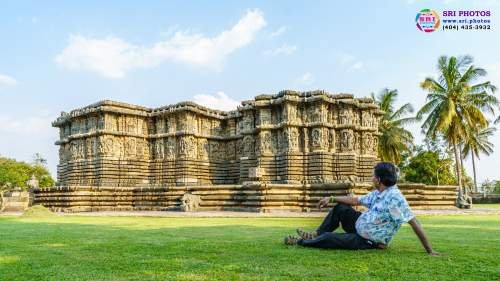
Sri Kedareswara Temple, Halebidu - Album 2
The Kedareswara Temple, situated in Halebidu, Hassan district, Karnataka, India, is a distinguished example of Hoysala architecture, celebrated for its intricate soapstone carvings and stellate design. Constructed around 1219 CE during the reign of King Veera Ballala II, this trikuta (three-shrined) temple, dedicated to Lord Shiva as Kedareswara, stands in the historic Hoysala capital of Dwarasamudra. Though smaller than the nearby Hoysaleswara Temple, it is equally significant, showcasing the Hoysala Empire’s architectural finesse and religious devotion. Managed by the Archaeological Survey of India (ASI) and proposed for UNESCO World Heritage status, the temple, despite damage from 14th-century invasions, remains a testament to medieval Indian craftsmanship.
Architectural Design
The Kedareswara Temple is constructed from chloritic schist (soapstone), a soft stone that hardens over time, enabling artisans to create detailed carvings. The temple measures approximately 30 meters long, 20 meters wide, and 8 meters high, built on a stellate (star-shaped) jagati (platform) with 16 angles, a hallmark of Hoysala architecture. This platform, about one meter high, facilitates a circumambulatory path (pradakshina patha) and enhances the temple’s visual prominence. The trikuta structure comprises three sanctums, with the central one housing a polished Shiva Lingam, while the lateral sanctums, likely dedicated to Vishnu and Brahma, reflect the Hoysalas’ pluralistic patronage.
The exterior walls are divided into two sections: the lower half features six horizontal friezes, and the upper half is adorned with approximately 180 sculptural panels and miniature towers (aediculae). The friezes depict elephants (symbolizing strength), lions (courage), scrollwork (floral motifs), horses (military prowess), mythological scenes, and dancers, showcasing the Hoysala emphasis on narrative art. The interior mandapa (pillared hall) contains lathe-turned pillars with geometric and floral patterns, supporting a ceiling with high-relief depictions of Shiva, Parvati, and celestial beings. The central shikhara (superstructure), though partially damaged, retains its curvilinear Dravidian form, decorated with arches and kirtimukhas (demon faces). The entrance porch, supported by polished pillars, features perforated stone screens (jalis) that filter light, creating a serene ambiance.
Construction Techniques
The temple’s construction involved sophisticated engineering, with soapstone sourced from quarries near Tumkur and Hassan. Artisans, organized into guilds, carved the stone in situ, using scaffolding for higher sections. The stellate platform required precise mathematical planning, with interlocking blocks ensuring stability. Lathe-turned pillars, crafted with rudimentary tools, achieved mirror-like finishes, a Hoysala specialty. Inscriptions indicate funding from royal grants and merchant contributions, with artisans like Mallitamma receiving land for their work.
Cultural Significance
The temple served as a religious and cultural hub, hosting rituals and performances, as depicted in its dancer friezes. Its pluralistic iconography, including Jain and Vaishnavite elements, reflects the Hoysalas’ inclusive patronage. Though no longer used for worship, the temple’s architectural legacy attracts scholars and tourists, complementing the nearby Hoysaleswara Temple.
Visitor Information
Located 31 km from Hassan and 149 km from Mysuru, the temple is open daily from 7:00 AM to 6:00 PM, with no entry fee. Visitors should wear modest attire and visit during October–February for cooler weather. Guided tours provide insights into the temple’s design, with the ASI museum nearby offering additional context.
Photography by Suresh K Volam | Sri Photos : https://www.sri.photos