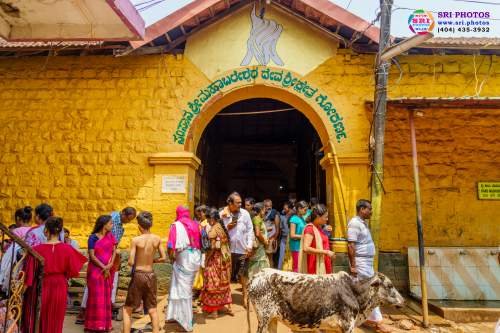
Sri Mahabaleswara Deva Sri Kshetra, Gokarna
Gokarna, a coastal town in the Uttara Kannada district of Karnataka, India, is renowned as a sacred pilgrimage center and a repository of ancient temple architecture. Situated along the Arabian Sea, Gokarna is often referred to as the "Kashi of the South" due to its religious significance, particularly for devotees of Lord Shiva. The town’s temples, most notably the Mahabaleshwar Temple, are celebrated for their historical depth, architectural simplicity, and spiritual vibrancy. Gokarna’s temples, set against a backdrop of pristine beaches and lush hills, reflect a blend of Dravidian architectural traditions and the cultural heritage of the Western Ghats region. This post explores the historical and architectural significance of Gokarna’s key temples, with a focus on the Mahabaleshwar Temple, a cornerstone of the town’s identity.
Historical Context
Gokarna’s religious importance is rooted in Hindu mythology, particularly its association with Lord Shiva. The name "Gokarna," meaning "cow’s ear" in Sanskrit, derives from a legend in which Shiva emerged from the ear of a cow (symbolizing Mother Earth) to grant a boon to Lord Brahma. The town is mentioned in ancient texts like the Skanda Purana and Mahabharata, underscoring its sanctity as one of the seven Muktikshetras (liberation-giving sites) in India. The Mahabaleshwar Temple, Gokarna’s most prominent shrine, is believed to house the Atmalinga, a sacred Shiva Lingam of immense spiritual potency, brought to earth by Ravana, the demon king of Lanka, as narrated in the Ramayana. The temple’s historical origins are traced to the 4th century CE, though the current structure reflects architectural developments from the Vijayanagara period (14th–16th centuries) and later renovations by local rulers and devotees. Inscriptions in Kannada and Sanskrit found in the temple precincts document endowments of land, gold, and villages by regional dynasties, including the Kadambas and Vijayanagaras, highlighting Gokarna’s role as a pilgrimage and cultural hub. Despite invasions and colonial influences, the temple complex has retained its sanctity, administered today by the Sri Ramachandrapura Math and the Hindu Religious and Charitable Endowments (HR&CE) Department.
Architectural Design
The Mahabaleshwar Temple exemplifies Dravidian architecture with a restrained yet elegant design, distinct from the ornate styles of other South Indian temples like those of the Cholas or Hoysalas. Constructed primarily from granite, the temple complex spans a modest area, with a low gopuram (entrance tower) adorned with carvings of Shiva, Parvati, and other deities. The main sanctum (garbhagriha) houses the Atmalinga, a 6-foot-tall Shiva Lingam partially submerged in a stone pit, accessible only to priests who perform rituals like abhishekam. The Lingam’s unique feature is its visibility only during specific rituals, adding to its mystique. The temple’s layout follows traditional Dravidian principles, with a rectangular courtyard enclosed by stone walls. The mandapa (pillared hall) features sturdy granite columns with minimal ornamentation, reflecting a focus on spiritual austerity rather than decorative excess.
A notable architectural element is the Dravida vimana, a stepped pyramidal tower above the sanctum, capped with a kalasa (finial). The tower, though modest compared to larger South Indian temples, is adorned with reliefs depicting Shiva’s various forms, including Nataraja and Ardhanarishvara. The courtyard includes smaller shrines dedicated to Ganesha, Parvati, and Subrahmanya, as well as a 12-foot Nandi statue carved from a single granite block, facing the sanctum with serene, polished features. Other temples in Gokarna, such as the Tamra Gauri Temple, Maha Ganapati Temple, and Bhadrakali Temple, complement the Mahabaleshwar Temple, each with simpler architectural designs. The Maha Ganapati Temple, located nearby, features a small vimana and a sanctum housing a Ganesha idol, believed to commemorate Ganesha’s role in safeguarding the Atmalinga from Ravana. These temples, built with local granite and laterite, blend harmoniously with Gokarna’s coastal landscape, their weathered stone surfaces bearing the patina of centuries.
Cultural and Religious Significance
The Mahabaleshwar Temple is a focal point for Shaivite worship, attracting pilgrims seeking spiritual liberation, particularly during festivals like Maha Shivratri and Kartika Purnima. The Atmalinga is revered as one of the most powerful Shiva Lingams, and rituals such as Rudrabhishekam and Sahasra Lingarchana draw thousands of devotees. The temple’s mythology, centered on Ravana’s penance and Shiva’s boon, is reenacted during festivals through recitations and processions, reinforcing its spiritual allure. The temple also serves as a center for Vedic learning, with priests trained in Agama Shastra conducting daily rituals with precision. Gokarna’s smaller temples contribute to its pluralistic religious fabric. The Tamra Gauri Temple, dedicated to Parvati, and the Maha Ganapati Temple are integral to the pilgrimage circuit, with devotees offering prayers to Ganesha before entering the Mahabaleshwar sanctum, following mythological tradition. The town’s coastal setting enhances its spiritual ambiance, with rituals often incorporating offerings from the Arabian Sea, such as coconuts and sandalwood paste. Historically, Gokarna was a hub for trade and cultural exchange, with its port facilitating interactions between South India and regions like Persia and Southeast Asia. The temples served as community centers, supporting education, charity, and festivals, as evidenced by inscriptions detailing donations from merchants and rulers. Today, Gokarna balances its spiritual heritage with growing tourism, offering a serene retreat for those seeking both devotion and natural beauty.
Visitor Experience and Modern Relevance
Located 150 km from Mangalore and 55 km from Karwar, Gokarna is accessible by road and rail, with the nearest railway station at Ankola (20 km away). The Mahabaleshwar Temple is open daily from 6:00 AM to 8:00 PM, with no entry fee, though special rituals require prior booking. Visitors are required to wear modest attire and remove footwear, and non-Hindus are restricted from entering the sanctum but may explore the courtyard. The best time to visit is October to March, when the weather is cool, and early mornings offer a tranquil experience with fewer crowds.
The temple complex, set amidst palm groves and near Gokarna’s beaches (such as Om Beach and Kudle Beach), provides a serene setting for exploration. Pilgrims and tourists can participate in or observe rituals, with evening aarti ceremonies illuminated by oil lamps creating a mystical ambiance. The town’s smaller temples and nearby hills, like the Bhadrakali Temple atop a hillock, offer additional points of interest. Guided tours, available through local operators, provide insights into Gokarna’s mythology and architecture, while the nearby Sri Ramachandrapura Math offers Vedic discourses. The Hoysaleswara Temple in Halebidu, 220 km away, offers a contrasting study in Karnataka’s temple architecture, making Gokarna a key stop in a broader heritage tour. Gokarna’s temples remain a living testament to India’s spiritual and cultural heritage, their simplicity and sanctity drawing devotees and scholars alike. The town’s blend of sacred sites, natural beauty, and historical depth ensures its enduring relevance as a pilgrimage and cultural destination.
Photography by Suresh K Volam | Sri Photos | https://www.sri.photos/