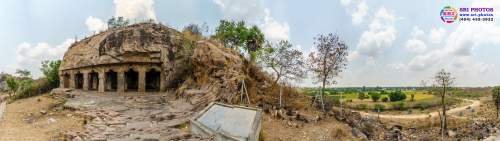
Pallava Caves, Mamandur
Opening Scene: Echoes in the Rock
The road from Kanchipuram winds through scrub and hill, dust swirling as I reach Mamandur. Four caves yawn from a granite face, their silence louder than any chant. These aren’t grand temples—they’re the Pallavas’ first whispers, carved between 610-668 CE under Mahendravarman I. No crowds flock here; it’s a secret kept by stone, a cradle of South India’s rock-cut art.
Historical Context: A Dynasty’s Dawn
Mahendravarman I, Pallava king and poet, stood here in the 7th century, his reign a pivot from wood to rock. These caves—four in a row—mark his experiment, a shift from perishable shrines to eternal stone. Inscriptions in Grantha script, among India’s oldest, sing his titles: “Gunabhara,” “Sankirnajati.” The Pallavas were testing their chisels, their ambitions soon birthing Mahabalipuram’s wonders. By the 8th century, these caves faded into obscurity, their solitude a shield from time’s ravages.
The Story: A King’s Signature
No grand myths cloak Mamandur, but history whispers through its inscriptions. Cave II, dubbed “Mahendravishnugriha,” honors Vishnu—a rare Pallava nod to the preserver. Local lore paints Mahendravarman as a visionary, his caves a canvas for innovation—music, poetry, and faith fused in rock. A tale persists: he meditated here, seeking divine favor for his fledgling dynasty. The caves’ unfinished edges hint at haste—war or succession cut his work short.
Architectural Insight: Raw Poetry in Stone
Cave I greets me, its facade a pillared porch, two columns freestanding like sentinels. Inside, twin lingams squat, their bases rough—Shiva’s raw presence. Cave II stuns: a Vishnu panel, his avatars in faint relief, a sculptor’s sketch paused mid-breath. Cave III boasts that inscription, its Sanskrit a royal autograph, while Cave IV, smallest, cradles a lingam in shadow. Sandstone swirls in reds and yellows, faint plaster traces hinting at lost murals. No gopurams rise here—just rock, hewn with rudimentary tools, their edges jagged. Dvarapalas—door guardians—glare from each entrance, their stern faces a Pallava trademark. The caves’ simplicity belies their genius: a dynasty learning to speak through stone, their flaws a map of growth.
The Exploration: A Silent Trek
I climb the hill, the sun searing, granite hot underfoot. Cave I’s porch offers shade; I trace the lingams, their coolness a shock. Cave II’s Vishnu panel flickers in dim light—Varaha, Narasimha, a faint Krishna—time’s erosion softening their lines. Cave III’s inscription demands a torch; I decipher “Mahendra,” a king’s echo in dust. Cave IV feels claustrophobic, its lingam a whisper in the dark. No priests chant here, no bells ring—just wind and the occasional crow. I sit, the silence thick, imagining Pallava hands chipping away, their sweat soaking this rock. A lizard skitters; a distant tractor hums. Mamandur’s solitude is its power—a raw, unfiltered past.
Beyond the Caves: A Faded Frontier
The hill overlooks fields—rice paddies, mango groves—Kanchipuram a haze on the horizon. No vendors hawk here; a lone tea stall brews chai for rare visitors. Nearby, the Pallava trail continues—Mahabalipuram’s pomp, Kailasanathar’s polish—but Mamandur feels like their genesis, a rough draft of greatness.
Final Reflection: Stone’s Silent Song
Dusk paints the caves amber, their mouths yawning wider. I linger, the rock cool now, its silence a balm. Mamandur isn’t a monument—it’s a moment, a Pallava king’s first stab at eternity. Here, stone speaks louder than scripture, and I listen, enthralled.
Photography by Suresh K Volam | Sri Photos : https://www.sri.photos