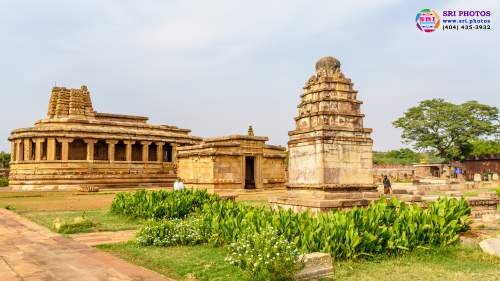
Aihole Monuments, Aihole
Aihole Monuments
Aihole (Kannada: ಐಹೊಳೆ; ancient Aryapura, Ayyavole) is a historic temple complex in Bagalkot district, northern Karnataka, India. Situated on the banks of the Malaprabha River, the site contains over 120 temples and rock-cut shrines dating primarily from the 6th to 8th centuries CE, with some additions from the 10th–12th centuries. Regarded as one of the cradles of Indian temple architecture, Aihole served as an architectural laboratory for the Early Chalukyas of Badami (c. 543–757 CE), where builders experimented with structural forms that later matured in nearby Badami, Pattadakal and Mahakuta. The monuments, mostly Hindu with a few Jain and one Buddhist example, represent the transition from rock-cut cave architecture to free-standing structural temples and are among the earliest surviving examples of the northern (Nagara) and southern (Dravida) styles in their nascent phases.
Historical Importance
Aihole was the first capital of the Early Chalukyas before the court moved to Badami around 543 CE under Pulakeshin I. The site continued as a major religious and cultural centre under Pulakeshin II (r. 610–642 CE), Mangalesha (r. 597–609 CE) and Vikramaditya II (r. 733–746 CE). More than thirty inscriptions in Kannada and Sanskrit found on temple walls and pillars provide crucial evidence of land grants, temple construction dates, titles of kings and names of architects and sculptors, making Aihole one of the best-epigraphically documented temple sites of the period.
The monuments reflect the political and religious ambitions of the Chalukyas, who positioned themselves as protectors of orthodox Brahmanical Hinduism while tolerating Jainism and, to a lesser extent, Buddhism. The presence of Vaishnava, Shaiva and Jain shrines side-by-side illustrates the religious syncretism of the age. After the decline of the Early Chalukyas, the Rashtrakutas (8th–10th centuries) and later the Kalyani Chalukyas (10th–12th centuries) added further temples, demonstrating the site’s enduring sanctity. The monuments escaped large-scale destruction during later Islamic invasions, preserving an almost continuous architectural record from the 6th to the 12th century.
Architectural Significance
Aihole is celebrated for its extraordinary diversity of architectural experimentation. Unlike the more stylistically uniform temples at Pattadakal (a UNESCO World Heritage Site 22 km away), Aihole displays multiple prototypes that influenced temple building across the Deccan and South India. Key architectural phases and features include:
- Rock-cut caves (6th century): The earliest monuments are rock-cut halls imitating wooden prototypes. The Ravana Phadi cave (mid-6th century) contains a garbhagriha with a Shiva linga, an antarala and a pillared mandapa, along with elaborate sculptural panels of dancing Shiva, Varaha and Durga Mahishasuramardini. The cave’s curved tower-like shikhara carved above the roof foreshadows later structural Nagara towers.
- Early structural temples (late 6th–7th century): The Lad Khan Temple (c. 550–600 CE), one of the oldest structural temples in Karnataka, has a flat-roofed square mandapa with a smaller shrine on the roof, resembling a village assembly hall (sala). Its thick, sloping stone slabs and perforated stone windows (jalis) imitate timber construction. The nearby Durga Temple (c. 700–725 CE) is the most evolved of the early series, featuring an apsidal (gajapristha) plan derived from Buddhist chaitya halls, a high basement mouldings, a partial northern-style shikhara and an open ambulatory. Its adhisthana (basement) and wall pilasters already display the fully developed Dravida idiom.
- Nagara-style experiments (7th–8th century): The Hucchimalli Gudi and Meguti Jain Temple (634 CE, dated by inscription) represent early attempts at the curvilinear Nagara tower. The Meguti Temple, built entirely of stone without mortar, is the earliest dated structural temple in Karnataka and carries an important inscription of Pulakeshin II.
- Vesara hybrid style (late 7th–8th century): Temples such as the Huchchappayya Matha and the Galaganatha group (c. 700 CE) show the emergence of the characteristic Chalukyan Vesara style, combining northern curvilinear towers with southern tiered basement and wall treatment. The Galaganatha Temple’s towering north-Indian shikhara rising above the Malaprabha is one of the finest early examples.
- Later additions (10th–12th century, Kalyani Chalukya and Hoysala influence): Temples such as the Tryambakeshwara group and the Ambigera Gudi exhibit more refined ornamentation, open mantapas with polished lathe-turned pillars and intricate ceiling panels that anticipate Hoysala craftsmanship.
Sculptural decoration at Aihole is equally remarkable. Doorframes carry Ganga-Yamuna figures, mithuna couples and floral scrolls, while wall niches contain high-relief images of river goddesses, Vishnu avatars and Shiva in various aspects. Ceiling panels in the Durga Temple and Konti Gudi display exquisite narrative friezes and lotus medallions.
Major Monument Groups
- Durga Temple complex (most visited; includes museum of the Archaeological Survey of India)
- Lad Khan–Kontigudi–Hucchimalli Gudi cluster
- Galaganatha group (about 30 temples along the river)
- Ravana Phadi and other rock-cut caves on the hill
- Meguti Hill (Jain temple and fort remains)
- Ambigera Gudi and Tryambakeshwara groups (later phase)
Present Status and Recognition
The monuments are protected by the Archaeological Survey of India as a Monument of National Importance. Though less visited than Pattadakal or Hampi, Aihole remains a critical site for understanding the evolution of Indian temple architecture. Scholars regard it as the “university of temple architecture” where the grammar of both Nagara and Dravida styles was first formulated. The complex continues to attract archaeologists, art historians and architecture students who trace the development from flat-roofed wooden prototypes to the towering vimanas and shikharas of medieval India. Standing amid the scattered sandstone temples against the Malaprabha’s quiet flow, visitors encounter one of the most complete records of early medieval Indian architectural experimentation—an open-air laboratory where the Chalukyas shaped the future of Hindu temple design.
Photography & Videography by Sri Photos - https://www.sri.photos/