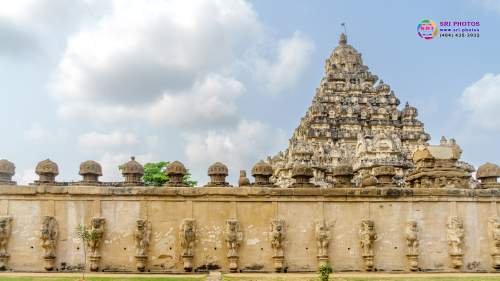
Kailasanathar Temple, Kanchipuram
Opening Scene: The Stone Symphony of Silence
Kanchipuram’s dawn unfurls in a haze of silk dust and temple smoke, the Kailasanathar Temple emerging like a granite dream from the town’s edge. Its vimana rises, a modest 40 feet, its tiers a weathered pyramid capped with a rounded finial, the morning sun igniting its tawny scars in gold. The air hums with the faint clack of looms and the musk of wet earth from overnight rain, a breeze tugging at the neem trees fringing the compound, their leaves rustling like a sigh. This is Shiva’s abode, a Pallava jewel from 685 CE, carved under Narasimhavarman II Rajasimha—a shrine where stone sings of an empire’s dawn. I step through the gateway, the ground gritty with sand, the scent of camphor and damp rock thick in my nostrils.
Historical Roots: Pallava Hands, Eternal Echoes
It’s the late 7th century, and Rajasimha paces this plot, his silk tunic fluttering, masons hunched over granite slabs, their chisels biting the stone in rhythmic clangs. Built between 685-705 CE, Kailasanathar marks the Pallavas’ leap from caves to temples, a prototype for Dravidian grandeur. Inscriptions in Grantha script—sharp, elegant—curl across the walls, praising Shiva as Kailasanatha, lord of the cosmic mount, and Rajasimha as a poet-king. By the 8th century, it stood complete, its sandstone glowing, a beacon spared by Muslim raids and colonial neglect. Today, it’s a quiet titan, its scars a map of Pallava ambition, its silence a hymn to centuries past.
The Myth: Shiva’s Mountain Home
A caretaker, his dhoti faded, leans against a pillar, his voice a gravelly whisper over the wind. Shiva descended here, they say, his Kailasa mountain mirrored in stone, a gift to the Pallavas’ devotion. Parvati joined him, their union a cosmic dance etched into the sanctum’s walls—her penance, his grace. Locals nod—the temple’s layout mimics the Himalayan peak, its chambers a pilgrimage through divine terrain. The lingam, a swayambhu giant, hums with creation’s pulse, a shard of Shiva’s might. The breeze agrees, its howl a faint echo of his trident’s song.
Architectural Grandeur: A Carved Cosmos
The vimana looms, its sandstone tiers a stepped ascent—lions prowl, gods glare, their edges softened by time, lichen blooming in green patches across the grain. I trace its base, the stone warm, pocked with chisel scars, its texture gritty under my nails. The enclosure wall unfurls, a riot of reliefs—Shiva slaying demons, Parvati mid-prayer, elephants lumbering, their trunks raised in frozen salute. Fifty-eight sub-shrines stud it, each a miniature cave, their dvarapalas—stern, slab-faced—guarding lingams squat and dark, the air inside thick with damp and silence. The sanctum burrows deep, the lingam massive, its surface glistening with oil, lamp light dancing across its curves. Mandapams sprawl, their pillars a forest—lotuses unfurl, nymphs twirl, their anklets silent but sharp, sandstone swirling in reds and yellows, faint plaster traces hinting at lost murals. A secret passage—narrow, shadowed—snakes beneath, a crawl to enlightenment, its walls cool and slick with moss. The courtyard stretches, its slabs worn smooth, the vimana’s shadow a fleeting guest on the ground.
The Experience: A Day in Shiva’s Shade
Dawn cracks at 6 a.m., the gate creaking open, the air sharp with neem and the tang of wet stone. I join a trickle of pilgrims—saris dripping river water, men with sandalwood paste—toward the sanctum. The sand sucks at my feet, cool and damp, the breeze tugging at my hair. Inside, the lingam stuns—lamp-lit, its sheen hypnotic; a priest pours milk, its white streams pooling in the stone’s crevices, steam curling upward like a spirit freed. A widow ties a thread, her prayer a whisper—health; a boy offers rice, its grains scattering like stars. By noon, the sun blazes, the sandstone searing; I retreat to a mandapam’s shade, tracing a lion’s mane, its curve smooth from centuries of touch. No crowds clog here—just silence, a sadhu’s hum, the rustle of leaves. Evening brings a hush—lamps flicker, their wicks spitting, the vimana a dark silhouette against a crimson sky, the air alive with the faint jingle of bells from afar.
Beyond the Walls: Kanchipuram’s Quiet Corner
Outside, Kanchipuram thrums—silk looms clatter, their threads dyed in temple hues; vendors hawk idli, their steam curling skyward. The trinity—Ekambaranath, Kamakshi, Varadharaja—pulses nearby, but Kailasanathar’s solitude pulls me—its stillness a Pallava heartbeat in the town’s weave.
Closing Frame: The Mountain’s Whisper
Dusk drapes the vimana in amber, the neem trees swaying, their shadows pooling deep. I linger, the stone cool now, the silence thick with Shiva’s presence. Kailasanathar isn’t a temple—it’s a mountain, a Pallava vow carved in sandstone, its scars singing of eternity.
Photography by Suresh K Volam | Sri Photos : http://www.sri.photos/