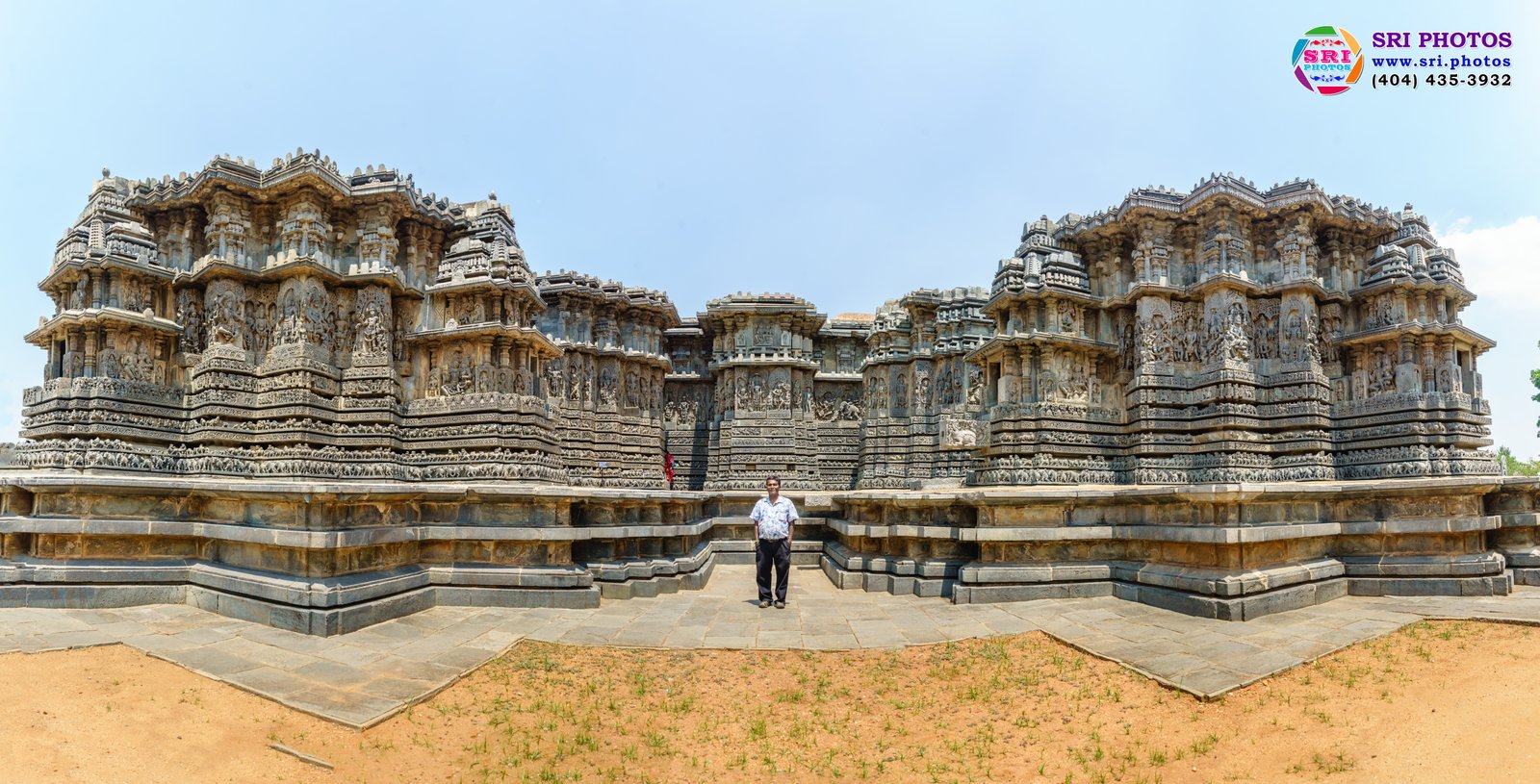
Hoysaleswara Temple, Halebidu - Album 1
The Hoysaleswara Temple, located in Halebidu, Hassan district, Karnataka, India, stands as one of the finest examples of Hoysala architecture and a testament to the cultural and artistic zenith of the Hoysala Empire. Dedicated to Lord Shiva, this 12th-century temple, constructed between 1121 CE and 1160 CE under the patronage of King Vishnuvardhana, is renowned for its intricate stone carvings, symmetrical design, and historical significance. Situated in what was once Dwarasamudra, the capital of the Hoysala Empire, the temple is part of a larger complex that includes the nearby Chennakesava Temple at Belur and is a proposed UNESCO World Heritage Site. Despite suffering damage during invasions in the 14th century, the Hoysaleswara Temple remains a living monument, actively used for worship and attracting scholars, historians, and tourists for its architectural splendor and cultural legacy.
Historical Context
The Hoysaleswara Temple was commissioned by King Vishnuvardhana, a pivotal ruler of the Hoysala Empire, whose reign (1108–1152 CE) marked a period of territorial expansion and cultural flourishing in southern India. The temple’s construction began in 1121 CE, as evidenced by inscriptions on the temple walls, which attribute its patronage to Vishnuvardhana and his queen, Shantala Devi, a noted patron of the arts and a Jain by faith. The temple, completed over several decades, possibly during the reign of Vishnuvardhana’s successors, was named after the king, whose title "Hoysala" (derived from the legend of a young warrior slaying a lion) became synonymous with the dynasty. Halebidu, originally called Dwarasamudra (meaning "gateway to the sea" due to its large artificial lake), served as the Hoysala capital from the 11th to the 14th century. The temple was a centerpiece of this bustling city, reflecting the empire’s wealth and devotion to Shaivism, though the Hoysalas also patronized Vaishnavism and Jainism, fostering a pluralistic religious culture. The temple’s inscriptions, written in Kannada and Sanskrit, detail endowments of land, gold, and villages, as well as the contributions of merchants and artisans, underscoring the temple’s role as a socio-economic hub. However, the Hoysala capital faced repeated invasions by the Delhi Sultanate, particularly under Malik Kafur in 1311 CE, leading to partial destruction of the temple complex, including the loss of its towering gopurams (entrance towers). Despite this, the temple’s core structure and sculptural details remain remarkably preserved, managed today by the Archaeological Survey of India (ASI) as a protected monument.
Architectural Design
The Hoysaleswara Temple exemplifies the Hoysala architectural style, characterized by its stellate (star-shaped) platform, intricate stone carvings, and meticulous craftsmanship. Constructed primarily from chloritic schist (soapstone), a soft stone that hardens with exposure, the temple allowed artisans to achieve unparalleled detail in their carvings. The temple complex measures approximately 105 meters long, 64 meters wide, and 9 meters high, making it one of the largest Hoysala temples. It is a dvikuta (twin-shrined) temple, with two sanctums (garbhagrihas) dedicated to Shiva as Hoysaleswara and Shantaleswara, named after the king and queen, respectively. Each sanctum houses a Shiva Lingam, and the twin shrines are connected by a shared navaranga (pillared hall).
Layout and Structure
The temple is elevated on a Jagati (platform) with a stellate plan, featuring 32 angles that create a star-like footprint, a hallmark of Hoysala architecture. This platform, about one meter high, provides a circumambulatory path (pradakshina patha) for devotees and enhances the temple’s visual grandeur. The temple’s exterior is divided into two main sections: the lower half, consisting of eight horizontal friezes, and the upper half, adorned with sculptural panels and miniature towers (aediculae). The absence of towering gopurams, likely destroyed during invasions, is compensated by two modest entrance porches on the eastern side, each supported by lathe-turned pillars. The interior features a mandapa (hall) with four rows of polished pillars, each uniquely carved with geometric patterns, floral motifs, and mythical creatures. The central ceiling panels are intricately sculpted with depictions of Shiva, his consort Parvati, and other deities, showcasing the Hoysala mastery of three-dimensional relief work. The twin sanctums are aligned along an east-west axis, each with its own sukhanasi (vestibule) and navaranga, creating a symmetrical yet dynamic spatial arrangement.
Sculptural Friezes and Iconography
The Hoysaleswara Temple is celebrated for its extensive sculptural program, with over 1,000 figurative reliefs and friezes that encircle the exterior walls, making it one of the most elaborately decorated temples in India. The lower friezes, arranged in eight parallel bands, depict a variety of subjects:
- Elephants: Over 1,000 elephants in dynamic poses, symbolizing strength and stability, form the lowest frieze.
- Lions: Representing courage, these alternate with elephants in a continuous band.
- Scrollwork: Intricate floral and vine patterns showcase the artisans’ skill.
- Horses: Depicting royal cavalry, these highlight the Hoysala military might.
- Birds: Stylized avians, possibly mythical hamsas (swans), symbolize grace.
- Mythological Scenes: Episodes from the Ramayana, Mahabharata, and Bhagavata Purana, including Krishna’s exploits and Rama’s battles, narrate Hindu epics.
- Dancers and Musicians: Figures in dynamic poses reflect the cultural importance of performing arts.
- Erotic Motifs: Subtle mithuna (amorous couples) carvings, inspired by Kamasutra aesthetics, signify fertility and prosperity.
The upper walls feature over 340 large sculptural panels, depicting deities such as Shiva, Vishnu, Brahma, Durga, Ganesha, and Saraswati, alongside celestial beings like apsaras (nymphs) and gandharvas (musicians). Notable sculptures include Shiva as Nataraja (cosmic dancer), Gajasurasamhara (slayer of the demon elephant), and Ravananugraha (Shiva granting a boon to Ravana). The temple’s shikhara (superstructure) above each sanctum, though partially damaged, retains its curvilinear form, adorned with miniature decorative arches and kirtimukhas (demon faces).
Two large Nandi (bull) statues, Shiva’s vehicle, flank the temple’s entrance, each carved from a single block of soapstone and measuring approximately 9 feet long and 7 feet high. Their polished surfaces and expressive features—alert ears, curved horns, and serene eyes—exemplify Hoysala sculptural finesse. The temple also includes Jain influences, attributed to Queen Shantala Devi, with carvings of Tirthankaras and Jain motifs integrated into the iconography, reflecting the Hoysalas’ religious pluralism.
Construction Techniques
The temple’s construction involved advanced engineering and artistic collaboration. Artisans, organized into guilds, worked under master sculptors like Ketana, Manthuka, and Malithamma, whose signatures appear on several carvings. The soapstone, sourced from local quarries, was carved in situ, with scaffolding used to access higher sections. The stellate platform required precise mathematical planning to ensure structural stability, while the lathe-turned pillars were crafted using rudimentary turning tools, a technique unique to the Hoysalas. Inscriptions indicate that the temple was funded by royal grants and contributions from wealthy merchants, with artisans receiving land and privileges for their work.
Cultural and Religious Significance
The Hoysaleswara Temple was not only a religious center but also a cultural and economic hub. It served as a venue for royal ceremonies, religious discourses, and artistic performances, with its mandapas hosting dance and music recitals. The temple’s inscriptions record donations of gold, land, and cattle, as well as the establishment of mathas (monasteries) and agrahara (scholarly settlements), highlighting its role in fostering education and community welfare. The coexistence of Shaivite, Vaishnavite, and Jain elements in the temple’s iconography reflects the Hoysalas’ inclusive patronage, aligning with Vishnuvardhana’s own transition from Jainism to Vaishnavism under the influence of Ramanujacharya, though the temple remained dedicated to Shiva.
Today, the temple remains an active site of worship, with daily rituals such as abhishekam (ritual bathing of the Shiva Lingam), archana, and aarti performed by priests. Major festivals, including Maha Shivratri and Kartika Purnima, draw thousands of devotees, with the temple illuminated by oil lamps and adorned with flowers. The ASI maintains the temple and its surrounding lawns, which feature a small museum housing artifacts from Halebidu’s excavations.
Visitor Experience and Modern Relevance
Located 31 km from Hassan and 149 km from Mysuru, the Hoysaleswara Temple is accessible by road, with regular bus services and taxis available from major Karnataka cities. The temple is open daily from 6:30 AM to 9:00 PM, with no entry fee, though donations are welcomed. Visitors are advised to wear modest attire and remove footwear before entering the sanctum. The best time to visit is October to February, when the weather is cool, and early mornings or late afternoons offer optimal lighting for photography of the carvings.
The temple’s sprawling courtyard, shaded by ancient trees, provides a serene setting for exploration. Guided tours, available through the ASI or local operators, offer insights into the temple’s history and iconography, with multilingual guides catering to international visitors. The intricate friezes and sculptures, which can take hours to fully appreciate, are best viewed with a magnifying glass to discern finer details. The nearby Belur Chennakesava Temple, 16 km away, complements a visit to Halebidu, offering a comparative study of Hoysala art.
The Hoysaleswara Temple’s enduring legacy lies in its architectural innovation and cultural synthesis. Its proposed UNESCO designation, alongside other Hoysala temples, underscores its global significance. The temple continues to inspire studies in art history, archaeology, and religious studies, while its spiritual ambiance attracts devotees seeking Shiva’s blessings. As a monument to the Hoysala Empire’s ingenuity, the Hoysaleswara Temple remains a timeless masterpiece, its soapstone carvings whispering tales of a golden age.
Photography by Suresh K Volam | Sri Photos | https://www.sri.photos/