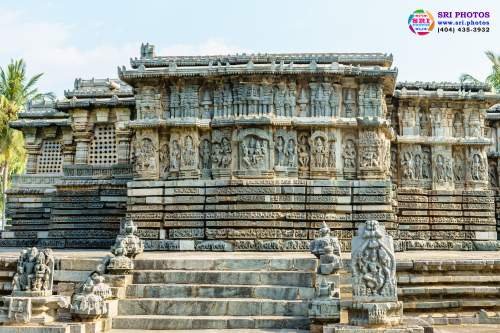
Sri Kedareswara Temple, Halebidu
The Kedareswara Temple, located in Halebidu, Hassan district, Karnataka, India, is a remarkable example of Hoysala architecture, renowned for its intricate soapstone carvings and historical significance. Dedicated to Lord Shiva as Kedareswara, this 12th-century temple was constructed around 1219 CE during the reign of Hoysala King Veera Ballala II. Situ Albaid in the former Hoysala capital of Dwarasamudra, alongside the more famous Hoysaleswara Temple, the Kedareswara Temple is a lesser-known yet equally exquisite monument, showcasing the Hoysala Empire’s artistic and religious legacy. Though partially damaged during 14th-century invasions by the Delhi Sultanate, the temple remains a significant site, protected by the Archaeological Survey of India (ASI) and proposed for UNESCO World Heritage status as part of the Hoysala temple ensemble.
Historical Context
The Kedareswara Temple was commissioned by King Veera Ballala II (r. 1173–1220 CE) and his queen Ketaladevi, as recorded in inscriptions found in the temple precincts. Built during the peak of the Hoysala Empire’s power, the temple reflects the dynasty’s devotion to Shaivism and their patronage of architectural innovation. Halebidu, then known as Dwarasamudra, was a thriving capital with a large artificial lake, palaces, and multiple temples, serving as a political and cultural hub. The Kedareswara Temple, though smaller than the nearby Hoysaleswara Temple, was a significant religious center, supported by royal endowments and contributions from merchants, as evidenced by Kannada inscriptions detailing grants of land, gold, and villages.
The temple’s history is intertwined with the Hoysala Empire’s fortunes. Following the invasions by the Delhi Sultanate, particularly Malik Kafur’s raid in 1311 CE, Dwarasamudra was sacked, and the temple suffered damage, including the loss of its superstructure (shikhara). Despite this, the core structure and its sculptural details endured, preserved by local communities until the ASI took over its maintenance in the 19th century. The temple, though no longer an active site of worship, stands as a testament to the Hoysala’s resilience and artistic prowess, offering insights into medieval South Indian history and religious practices.
Architectural Design. The Kedareswara Temple exemplifies the Hoysala architectural style, characterized by its stellate (star-shaped) platform, intricate soapstone carvings, and precise engineering. Constructed from chloritic schist (soapstone), a soft stone that hardens with exposure, the temple allowed artisans to create detailed carvings that remain sharp despite centuries of weathering. The temple is a trikuta (three-shrined) structure, with three sanctums dedicated to Shiva, though only the central sanctum houses a Shiva Lingam, while the lateral sanctums are dedicated to related deities, possibly Vishnu and Brahma, reflecting the Hoysalas’ pluralistic religious outlook.
Layout and Structure
The temple is elevated on a jagati (platform) with a stellate plan featuring 16 angles, creating a star-like footprint that enhances both aesthetic appeal and structural stability. The platform, approximately one meter high, provides a circumambulatory path (pradakshina patha) for devotees and elevates the temple above the surrounding landscape. The temple measures about 30 meters in length and 20 meters in width, smaller than the Hoysaleswara Temple but equally intricate. The exterior walls are divided into two sections: the lower half features six horizontal friezes, and the upper half is adorned with sculptural panels and miniature towers (aediculae). The interior mandapa (pillared hall) features lathe-turned pillars, a hallmark of Hoysala craftsmanship, with intricate geometric and floral motifs. The ceiling panels, sculpted in high relief, depict Shiva, Parvati, and other deities, showcasing three-dimensional artistry. The central sanctum, topped by a partially damaged shikhara with a curvilinear Dravidian form, houses a polished Shiva Lingam, while the lateral sanctums, though empty, retain their architectural symmetry. The temple’s entrance, marked by a modest porch, is supported by polished pillars with bell-shaped bases and fluted shafts.
Sculptural Program
The Kedareswara Temple is renowned for its sculptural richness, with over 500 reliefs and friezes encircling the exterior walls. The six horizontal friezes include:
- Elephants: Depicting strength, with hundreds in varied poses.
- Lions: Symbolizing courage, alternating with elephants.
- Scrollwork: Intricate floral and vine patterns showcasing artisan skill.
- Horses: Representing military prowess.
- Mythological Scenes: Episodes from the Ramayana, Mahabharata, and Bhagavata Purana, such as Krishna’s dance with the gopis.
- Dancers and Musicians: Reflecting the Hoysala patronage of performing arts.
The upper walls feature approximately 180 sculptural panels, depicting deities like Shiva (Nataraja, Tripurantaka), Vishnu, Durga, and Ganesha, alongside celestial figures like apsaras. Jain influences, possibly due to Queen Ketaladevi’s patronage, are evident in Tirthankara carvings. The sculptures, signed by artisans like Mallitamma, exhibit fine details, such as jewelry and expressive faces, visible with close inspection. A notable feature is the perforated stone screens (jalis) that filter light into the mandapa, creating a serene ambiance.
Construction Techniques
The temple’s construction involved advanced engineering, with soapstone sourced from local quarries near Tumkur and Hassan. Artisans, organized into guilds, carved the stone in situ, using scaffolding for higher sections. The stellate platform required precise mathematical planning, with interlocking stone blocks ensuring stability. Lathe-turned pillars were crafted using rudimentary turning tools, producing mirror-like finishes. Inscriptions indicate funding from royal grants and merchant contributions, with artisans receiving land and privileges for their work.
Cultural and Religious Significance
The Kedareswara Temple served as a religious and cultural center, hosting rituals, performances, and community gatherings. Its pluralistic iconography, blending Shaivite, Vaishnavite, and Jain elements, reflects the Hoysalas’ inclusive patronage. Inscriptions record endowments supporting mathas (monasteries) and agrahara (scholarly settlements), highlighting the temple’s role in education and welfare. Though no longer used for worship, the temple’s historical significance endures, attracting scholars studying Hoysala art and architecture. The temple’s proximity to the Hoysaleswara Temple, just 1 km away, underscores Halebidu’s role as a spiritual hub. Its carvings, depicting epics and deities, served as visual scriptures, educating devotees and glorifying Hoysala patronage. Today, the temple is a key site for understanding medieval Indian temple architecture and its socio-religious context.
Visitor Experience and Modern Relevance
Located 31 km from Hassan and 149 km from Mysuru, the Kedareswara Temple is accessible by road, with regular bus services and taxis from major Karnataka cities. The temple is open daily from 7:00 AM to 6:00 PM, with no entry fee, though donations are welcomed. Visitors are advised to wear modest attire and allocate 1–2 hours to explore the carvings and surrounding ruins. The best time to visit is October to February, when cooler weather enhances the experience, and early mornings offer optimal lighting for photography. The temple’s compact courtyard, shaded by trees, provides a tranquil setting for exploration. Guided tours, available through the ASI or local operators, offer insights into the temple’s history and iconography. The intricate friezes and panels, best viewed with a magnifying glass, reveal minute details like jewelry and facial expressions. The nearby Hoysaleswara Temple and the ASI museum, housing artifacts from Halebidu’s excavations, complement a visit, offering a comprehensive view of Hoysala heritage. The Kedareswara Temple’s architectural elegance and historical depth make it a vital part of Karnataka’s cultural landscape. Its proposed UNESCO designation, alongside other Hoysala temples, underscores its global significance. As a monument to the Hoysala Empire’s artistry and devotion, the temple continues to inspire awe and scholarly interest, standing as a timeless relic of India’s medieval heritage.
Photography by Suresh K Volam | Sri Photos | https://www.sri.photos/