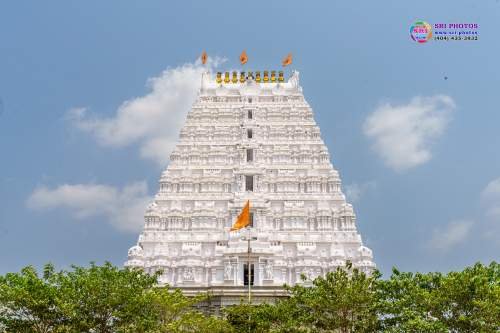
Srikalahasti Temple, Srikalahasti
Opening Scene: The Winds of Devotion
The sun dips low over the dusty plains of Andhra Pradesh, casting golden streaks across the Swarnamukhi River. Ahead looms the Srikalahasti Temple, its towering gopuram piercing the horizon like a sentinel of the divine. This isn’t just a temple—it’s a living legend, a sacred vortex where wind itself bows to Lord Shiva. Known as one of the Panchabhoota Sthalams, representing the element of air, Srikalahasti hums with a primal energy that’s drawn pilgrims for over a millennium. As I step closer, the breeze picks up, whispering tales of spiders, snakes, and elephants—creatures who, in myth, earned their salvation here.
Historical Roots: A Tapestry of Time
The temple’s origins stretch back to at least the 5th century, when the early Cholas carved its first sanctum from the hillside. But it was the later Cholas, Pallavas, and Vijayanagara kings who sculpted its grandeur, layer by layer. By the 16th century, Krishnadevaraya, the Vijayanagara emperor, added the majestic 120-foot gopuram, a gateway adorned with stucco deities frozen in mid-dance. Inscriptions from the 11th century, etched in Tamil, praise Shiva as Kalahasteeswara, lord of this windswept kshetra. Historians argue its rock-cut core predates even these records, hinting at a tribal shrine swallowed by empires. Today, it’s a palimpsest of dynasties, each leaving their mark in stone and story.
The Legend: A Trio of Devotees
The name Srikalahasti weaves a fable into its very syllables—Sri for spider, Kala for snake, Hasti for elephant. Local priests recount it with relish: a spider wove webs to shield Shiva’s lingam, a snake adorned it with gems, and an elephant bathed it with river water. Their rivalry—web torn, gems scattered, water muddied—angered Shiva, who cursed them to mortality, only to grant moksha when they repented. This trio’s tale isn’t just folklore; it’s etched into the temple’s ethos, a reminder of devotion’s many forms. Pilgrims nod knowingly—here, even the smallest creature finds grace.
Architectural Marvel: Stone and Spirit
Crossing the threshold, I’m dwarfed by the gopuram’s riot of carvings—gaping lions, twirling nymphs, Shiva mid-tandava. Inside, the temple sprawls across 5 acres, a maze of white marble corridors and shadowy chambers. The sanctum lies deep within, carved into the hill itself, where the Vayu Lingam—a swayambhu, self-manifested stone—sits. It’s rough, unpolished, pulsing with an otherworldly vibe. A priest lights a camphor flame; it flickers wildly, though no breeze stirs the air. “The lingam breathes,” he says, eyes gleaming. Science shrugs—air vents, perhaps—but faith insists it’s Shiva’s breath, the wind element alive. The outer courtyard boasts a thousand-pillared hall, its columns etched with Tamil hymns. Narrow passages twist beneath, some sealed, others rumored to hide treasures or escape routes from medieval sieges. The Vijayanagara gopuram, though weathered, stands firm, its base a fortress against time. Nearby, a sacred tank glints, its waters a pilgrimage dip for those seeking Rahu-Ketu’s cosmic balm—this is a famed dosha nivarana kshetra, after all.
The Experience: A Pilgrim’s Pulse
Dawn breaks, and the temple hums with life. Bells clang, chants rise—Om Namah Shivaya—as saffron-robed priests pour milk over the lingam. Pilgrims, some barefoot from miles away, clutch offerings: sandalwood, flowers, salt and pepper for skin ailments, a nod to its healing lore. I join the queue, the marble cool underfoot, the air thick with incense. The sanctum’s dimness envelopes me; the flame dances again, a hypnotic sway. A woman whispers her son’s horoscope woes—Rahu’s grip, she fears. Another ties a thread to a neem tree, praying for marriage. Here, faith is tactile, urgent, alive. Outside, hawkers peddle brass lamps and prasadam—sweet ladoos laced with ghee. The Swarnamukhi flows sluggish nearby, its banks dotted with sadhus in meditative hush. By noon, the heat climbs, but the temple’s inner coolness beckons—a sanctuary from both sun and sin. Evening brings the Maha Shivaratri vibe year-round, with lamps lighting the gopuram like a celestial crown.
Beyond the Walls: A Town in Tune
Srikalahasti isn’t just its temple—it’s a town woven around it. Silk weavers clack looms nearby, crafting saris dyed in temple hues—reds, golds, greens. The market buzzes with pilgrims bartering for trinkets, their chatter a polyglot hymn: Telugu, Tamil, Kannada. A stone’s throw away, the hill offers a trek to Kannappa Temple, honoring a hunter-turned-devotee who plucked his eyes for Shiva—an extreme piety etched in local lore.
Closing Frame: The Wind’s Whisper
As dusk paints the gopuram amber, I linger by the river. The breeze lifts again, carrying chants and the faint jingle of bells. Srikalahasti feels eternal—not just a place, but a pulse, a breath of Shiva himself. They call it Dakshina Kailasam, the southern Kailasa, and standing here, I believe it. The wind agrees.
Photography, Videography & Live Coverage by Sri Photos - https://www.sri.photos/