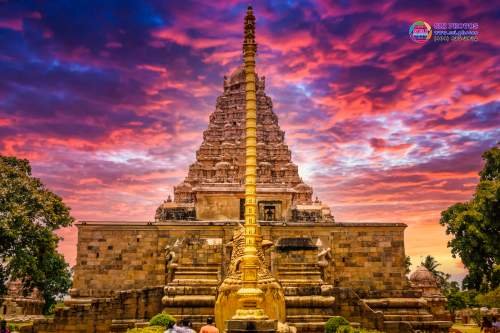
Brihadeeswarar Temple, Gangaikonda Cholapuram
The Brihadeeswarar Temple (Arulmigu Peruvudaiyar Temple) is a Hindu temple is a UNESCO World Heritage Site dedicated to Lord Shiva in Gangaikonda Cholapuram, Jayankondam, in Tamil Nadu, India constructed by Rajendra Chola I (son of Raja Raja Chola I) in 1035 AD as a part of his new capital. The Brihadeeswarar Temple is located near the village of Gangaikonda Cholapuram, about 280 km southwest of Chennai and 50 km from Chidambaram. The Archaeological Survey of India (ASI) administers the temple as a protected heritage monument.
Rajendra Chola wanted to emulate the temple built by his father after his victory in a campaign across India that Chola era texts state covered Karnataka, Andhra Pradesh, Odisha, and Bengal. After his victory, he demanded that the defeated kingdoms send pots of Ganges River water and pour them into the temple's well. The well was originally called Cholagangam as it was filled with water from Ganges. Rajendra I, as is Tamil tradition, then assumed the name Gangaikonda Cholan, meaning the one who conquered the Ganges. He established Gangaikonda Cholapuram as his capital from the earlier Chola capital of Thanjavur.
The temple is similar in design and has a same name of the Brihadeeswarar Temple in Thanjavur. The Gangaikonda Cholapuram Temple is smaller yet more refined than the Thanjavur Temple. Both are among the largest Shiva temples in South India and examples of Dravidian style temples. The temple is also referred to in texts as Gangaikonda Cholapuram Temple or Gangaikondacholeeswaram Temple. In addition to the main shrine, the temple complex has a number of smaller shrines, gopura, and other monuments.
The temple is famed for its bronze sculptures, artwork on its walls, the depiction of Nandi and the scale of its tower. There are five shrines around the sanctum and a Lion well, which was added during the 19th century. The temple site has a monolithic representation of Navagrahas. The Sri-vimana at Gangaikonda has nine storeys (talas) including those at the lower levels, in contrast to the thirteen storeys at Thanjavur. Each storey has a square-circle-oblong artwork. The upper levels repeat the lower-level design in a rhythmic shrinking pattern giving the vimana an uncommon parabolic form.
Gangaikonda Cholapuram – the capital of a powerful Asian empire from around for over three centuries along with its other major Chola-era Hindu temples have been completely destroyed leaving this active temple. It is built in Dravidian architecture with a square plan. The original courtyard is two squares stacked next to each other, all Mandapas, the Upapitham, the shrine plans, the Garbhagriha and the tower elements are all square shaped and incorporate circles and principles of geometric symmetry. The structural elements resemble the big Brihadisvara Temple in Thanjavur.
The temple complex includes Nandi Mandapa, Alankar Mandapa, Maha Mandapa, Mukha Mandapa and Ardha Mandapa. Some of these were added and restored by Hindu kingdoms after the 14th century. The main temple is built on an elevated structure with the courtyard. Its sanctum is entered through the Ardha Mandapa and doorway is flanked by Dvarapalakas. The sanctum contains Brihadeeswarar in the form of Lingam 13 ft tall and the base has a circumference 59 ft.
Photography by Suresh K Volam | Sri Photos - http://www.sri.photos