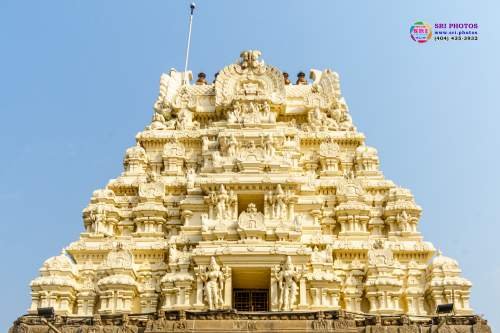
Kamakshi Ambal Devasthanam, Kanchipuram
Kamakshi Temple is an ancient Hindu Temple dedicated to Kamakshi, the ultimate Goddess Lalita Maha Tripura Sundari. This temple is located in the historic city of Kanchipuram in Tamil Nadu, India. The Temple is believed to be built by the Pallava kings, whose capital was Kanchipuram, around 6th century. There are also arguments that the old Kanchi temple is the Shakti Peetha, where Sankaracharya has installed the Shri Chakra. It is one of the seven Mokshapuris (the other six are: Ayodhya, Mathura, Maya Kashi, Kanchi, Avantika Puri and Dwarakavati) and one of the 51 Shakti Peethas. The naval part of Sati Devi's body is believed to have fallen here. There are 51 Shakti Peeth linking to the 51 alphabets in Sanskrit
The Image of the main Deity, Kamakshi, is seated in a majestic Padmasana, a yogic posture signifying peace and prosperity, instead of the traditional standing pose. Goddess holds a sugarcane bow and bunch of five flowers in the lower two of her arms and has a Pasha, an Ankusha in her upper two arms. There is also a parrot perched near the flower bunch. There are no other Goddess temples in the city of Kanchipuram, apart from this temple, which is unusual in a traditional city that has hundreds of traditional temples.
According to a local legend, Adi Shankaracharya established the Sri Chakra in this Kamakshi Devi temple in the trough-like structure in that shrine. As per Hindu scriptures, Kamakshi Amman is considered in line with Meenakshi at Madurai and Visalakshi at Varanasi. Kamakshi is the only Shakti shrine centered across all Shiva temples in Kanchipuram which do not have separate shrines for Amman. Kamakshi is worshipped thus as Parabrahma Swaroopini. She is none other than Lalitha Maha Tripura Sundari herself. This can be further supported in tantric texts such as Tripura Rahasya, Bahvricha Upanishad and most importantly, Brahmanda Purana which discusses how Lalitha Devi resides in Kamakoti Peetha in Kanchi.
The temple occupies an area of 5 acres. The temple complex is dotted with Sannidhis, Mandapas, and Pushkarini(temple tank) - all rich in architectural splendour and with intricate carvings. The temple is surrounded by Gopuras on all four sides. The sanctum houses the image of Kamakshi in seated posture and is flanked by the trinity of Shiva, Vishnu and Brahma. There are smaller shrines of Bangaru Kamakshi, Adi Shankara and Maha Saraswathi around the sanctum. In front of the Grabagriha there is a Gayatri Mandapam. To the right of the shrine we can see the deities Arupa Lakshmi and Swaroopa Lakshmi.
The shrine situated in front of Sri Kamakshi’s Garbhagriha is of Sage Durvasas, also known as Krodha Bhattaraka. There are thirty-two chief upasakas of Devi like Manu, Chandra, Kubera etc. Among these, Kamaraja, Lopamudra and Durvasa are the chief Upasakas. Durvasa Pranita vidya is called Sadi vidya. Durvasa represents the power of sattvika krodha of Amba, used to protect and correct her devotees, and thus her limitless kriya shakti. It is Sri Durvasa who established the Kamakoti Peetha by consecrating a Bhu-Prastara Srichakra in front of Amba. Due to a curse by Saraswati, he was born as a deaf and dumb brahmana and was graced by Sri Kamakshi with Anugraha Diksha.
Photography by Suresh K Volam | Sri Photos : http://www.sri.photos/