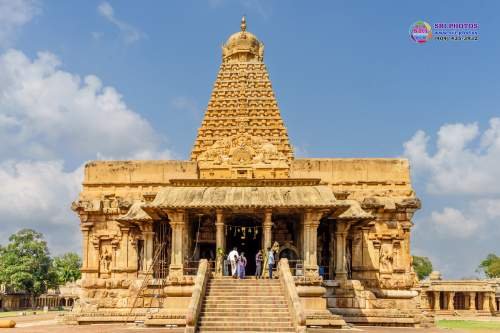
Brihadisvara Temple, Tanjavur
Brihadisvara Temple or Peruvudaiyar Kovil, is a Hindu temple dedicated to Lord Siva built in a Chola architectural style on the south bank of the River Cauvery in Tanjavur, Tamil Nadu, India. The temple is a part of the UNESCO World Heritage Site known as the 'Great Living Chola Temples', along with the Gangaikonda Cholapuram temple and Airavatesvara temple. Brihadishwara is a Sanskrit word which means Brihat (Big) + Iswara (Siva) or the great Lord Siva. It was built by Rajaraja Chola between 1003 and 1010. The temple has a massive Prakara (corridor) and one of the largest Siva Lingas in India. The Peruvudaiyar temple's plan and development utilizes the axial and symmetrical geometry rules. It is classified as Perunkoil (also called Madakkoil), a big temple built on a higher platform of a natural or man-made mounds. The temple complex is a rectangle that is almost two stacked squares, covering 790. 0 ft East to West, and 400 ft North to South. In this space are five main sections: the sanctum with the towering superstructure (Sri Vimana), the Nandi Hall in front (Nandi-mandapam) and in between these the main community hall (mukhamandapam), the great Mahamandapam and the pavilion that connects the great hall with the Sanctum.
The temple complex integrates a large pillared and covered Prakara in its spacious courtyard, with a perimeter of about 1,480 ft. Outside this pillared veranda there are two walls of enclosure. They made the outer wall high, isolating the temple complex area. On its east end is the original main gopuram or gateway that is barrel vaulted. It is less than half the size of the main temple's vimana. Additional structures were added to the original temple after the 11th century, such as a mandapa in its northeast corner and additional gopurams on its perimeters to allow people to enter and leave from multiple locations. Some of the shrines and structures were added during the Pandya, Nayaka, Vijayanagara and Maratha era, before the colonial era started, and these builders respected the original plans and symmetry rules. Inside the original temple courtyard, along with the main sanctum and Nandi-mandapam are two major shrines, one for Kartikeya and for Parvati. The complex has additional smaller shrines.
The Peruvudaiyar temple continued the Hindu temple traditions of South India by adopting architectural and decorative elements, but its scale significantly exceeded the temples constructed before the 11th century. The Chola era architects and artisans innovated the expertise to scale up and build, particularly with heavy stone and to accomplish the 208 ft high towering vimana. The temple faces east, and once had a water moat around it. This has been filled up. The fortified wall now runs around this moat. The two walls have ornate gateways called the gopurams. These are made from stone and display entablature. The main gateways are on the east side. The first one is called the Keralantakan tiruvasal, which means the 'sacred gate of the Keralantakan'. The word Keralantakan was the surname of king Rajaraja who built it. About 330 ft ahead is the inner courtyard gopuram called the Rajarajan tiruvasal. This is more decorated than the Keralantakan tiruvasal, such as with its adhishthanam relief work narrating scenes from the Puranas and other Hindu texts. The inner eastern gopuram leads to a vast courtyard, in which the shrines are all signed to east–west and north-west cardinal directions.
The complex can be entered either on one axis through a five-story gopuram or with a second access directly to the huge main quadrangle through a smaller free-standing gopuram. The gopuram of the main entrance is 30 m high, smaller than the vimana. The main temple-related monuments and the great tower is in the middle of this courtyard. Around the main temple that is dedicated to Shiva, are smaller shrines, most of which are aligned axially. These are dedicated to his consort Parvati, his sons Murugan and Ganesha, Nandi, Varahi, Karuvur deva (the guru of Rajaraja Chola), Chandeshvara and Nataraja. The Nandi mandapam has a monolithic seated bull facing the sanctum. In between them are stairs leading to a columned porch and community gathering hall, then an inner mandapa connecting to the pradakshina patha, or circumambulation path. The Nandi facing the mukh-mandapam weighs about 25 tonnes. It is made of a single stone and is about 2 m in height, 6 m in length and 2. 5 m in width. The image of Nandi is a monolithic one and is one of the largest in the country.
The sanctum is at the center of the western square. It is surrounded by massive walls that are divided into levels by sharply cut sculptures and pilasters providing deep bays and recesses. Each side of the sanctuary has a bay with iconography. The interior of the sanctum sanctorum hosts an image of the primary deity, Shiva, in the form of a huge stone linga. It is called Karuvarai, a Tamil word that means 'womb chamber'. This space is called Garbhagriha in other parts of India. Only priests are allowed to enter this inner-most chamber. The main Vimana is a massive 16 storeys tower of which 13 are tapering squares. It dominates the main quadrangle. It sits above a 99. 0 ft sided square. The tower is elaborately articulated with Pilaster, piers (a raised structure), and attached columns which are placed rhythmically covering every surface of the vimana. The sikhara, a cupolic dome (25 tons), is octagonal and rests on a single block of granite, weighing 80 tons.
Hindu deities sculpted on the temple are:
East wall: Lingodbhava, standing Shiva, Pashupata-murti, plus two dvarapalas flanking the pathway from ardha-mandapam
South wall: Bhikshatana, Virabhadra, Dakshinamurti, Kalantaka, Nataraja plus two dvarapalakas
West wall: Harihara, Lingodbhava, Chandrashekhara without prabhavali, Chandrashekhara with prabhavali, and two dvarapalakas
North wall: Ardhanarishvara, Gangadhara without Parvati, Pashupata-murti, Shiva-alingana-murti, and two dvarapalakas
The Temple turned 1000 years old in September 2010. To celebrate the 1000th year of the grand structure, the state government and the town held many cultural events. It was to recall the 275th day of his 25th regal year (1010) when Rajaraja I (985–1014) handed over a gold-plated Kalasam (copper pot or finial) for the final consecration to crown the vimana, the 59. 82 m tall tower above the sanctum.
Photography, Videography & Live Coverage by Sri Photos - https://www.sri.photos/