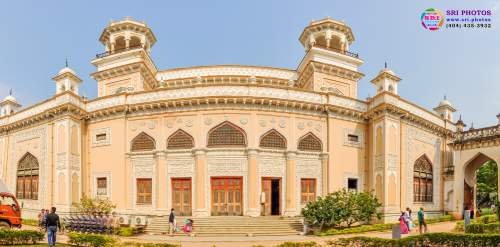
Chowmahalla Palace, Hyderabad
Chowmahalla Palace is the palace of the Nizams located in Hyderabad, Telangana, India. It was the seat of power of the Asaf Jahi dynasty (1720-1948) and was the official residence of the Nizams during their reign. The palace has been converted into a museum and the ownership still lies with the family. The palace was constructed at the location of an earlier palace of the Qutb Shahi Dynasty and Asaf Jahi Dynasty close to Charminar. Construction of the palace was started by Nizam Ali Khan Asaf Jah II in 1769. He ordered the building of four palaces from which the nomenclature of Chau Mahalla is derived. The word chār or chow, means "four" and the word mahal means "palace". While Salabat Jung initiated its construction in 1750, the palace was completed by the period of Afzal ad-Dawlah, Asaf Jah V between 1857 and 1869. The palace consists of two courtyards as well as the grand Khilwat (the Darbar Hall), fountains and gardens. The palace originally covered 45 acres while only 12 acres remain.
Southern Courtyard is the oldest part of the palace, consisting of four palaces Afzal Mahal, Mahtab Mahal, Tahniyat Mahal and Aftab Maha built symmetrically opposite each other in Neoclassical style. The forecourt in-between the palaces is adorned with a pond and a beautiful garden. The neoclassical palaces have double-height verandahs or façades lined with European style columns. The columns in the Aftab Mahal and Mehtab Mahal are of Ionic order whereas the Afzal Mahal and Tehniyat Mahal have Corinthian columns.
Northern courtyard has Bara Imam, a long corridor of rooms on the east side facing the central fountain and pool that once housed the administrative wing and Shishe-Alat, meaning mirror image. It has Mughal domes and arches and many Persian elements such as the ornate stucco works that adorns the Khilwat Mubarak. These were characteristic of buildings built in Hyderabad at the time. Opposite the Bara Imam is a building that is its shishe or mirror image. The rooms were once used as guest rooms for officials accompanying visiting dignitaries.
Khilwat Mubarak is heart of Chowmahalla Palace. It is held in high esteem by the people of Hyderabad, as it was the seat of the Asaf Jahi dynasty. The grand pillared Durbar Hall has a pure marble platform on which the Takht-e-Nishan or the royal seat was laid. Here the Nizams held their durbar and other religious and symbolic ceremonies. The 19 spectacular Chandeliers of Belgian crystal were recently reinstalled to recreate the lost splendour of this regal hall. The main gateway to the Chowmahalla Palace on the western hand has a clock tower also known as a Khilafat clock. The tower is three storeys high and consists of balconies and jharokha of Mughal style same as the style of half domes. It has been ticking since 1750. An expert family of horologists winds the mechanical clock every week.
Council Hall housed a rare collection of manuscripts and priceless books. The Nizam often met important officials and dignitaries here. Today it is a venue for temporary exhibitions from the treasures of the Chowmahalla Palace Collection of the bygone era. The Sixth Nizam, Mir Mahbub Ali Khan, is believed to have lived in Roshan Begum named after his mother. The former Nizam (Barkat Ali Khan Mukarram Jah) and his family decided to restore the Chowmahalla Palace and open it to the public in January 2005. It took over 5 years to document and restore the palaces of the first courtyard to its former glory. The palace also has a collection of vintage cars, including the Rolls-Royce, which the Nizam Kings used. Marble statue of wrestlers, Afzal Mahal, Chowmahalla Palace. The project was awarded the UNESCO Asia Pacific Merit award for cultural heritage conservation on 15 March 2010. UNESCO representative Takahiko Makino formally handed over the plaque and certificate to Princess Esra, former wife and GPA holder of Prince Mukarram Jah Bahadur.
Photography & Videography by Sri Photos - https://www.sri.photos/